What is a company seal, and do you still need one?
A company seal, also called a common seal or corporate seal, is a mark identifying the company that issued a document. In most common law countries it stopped being legally required decades ago, and in ordinary practice it is still expected.
What is a company seal, and do you still need one? templates, ready to edit
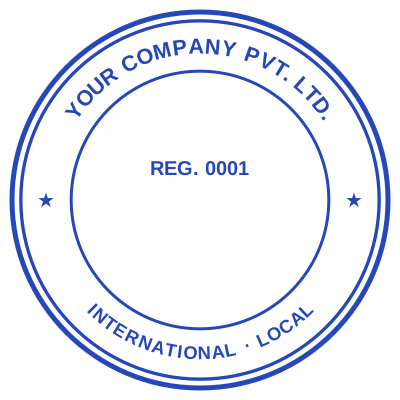



Open the stamp maker with any of these
Every preview on this page carries a faint Estamplab watermark. Your own download does not: the editor renders your stamp again, clean, as a transparent PNG, an SVG or a PDF. See the full template library.
This is one of the few questions where the legal answer and the practical answer point in opposite directions, which is why it gets asked so often. Most searches for a company seal are made by somebody who has been asked for one and wants to know whether they really need it. The short version: in law, usually not. In practice, frequently yes, because the bank, the registry or the counterparty asking will not process the document without it.
What you get
- A common seal, a corporate seal and a company chop are the same object under different names.
- The UK abolished the requirement for a common seal in 1989 and made it optional; many jurisdictions followed.
- A document signed by an authorised person is ordinarily valid whether or not it carries a seal.
- In China, Hong Kong, Taiwan, Japan and Korea, the chop carries weight a signature does not, and its custody is controlled.
- Banks, registries and large counterparties often require the mark regardless of what the law says.
- What decides your document is the body receiving it, not a general rule.
How to make it
- Open the stamp maker and pick a shape, or start from a template.
- Type your wording, then set the colour, border and size.
- Add the date, time, serial number or logo, and position each one.
- Preview it live, then download. Designing and previewing are free.
Questions
What is a common seal of a company?
A common seal is the company's own mark, historically an embossed die pressed into the paper, carrying the registered name and often the registration number. It was once the only way a company could execute a deed. Today it is an identifier: it says which company issued this document. It is not a signature, and it does not by itself show that anybody with authority approved anything.
What is a corporate seal, and is it different?
Corporate seal is the American term for the same thing, and it is likewise no longer required by the corporation law of any US state for ordinary contracts. Companies keep them for tradition, for banks that still ask, and for stock certificates and corporate kits, which is why they are still sold in binder sets.
Is a document valid without a company seal?
Ordinarily yes. In the UK, section 36A of the Companies Act 1985 and later the Companies Act 2006 made the common seal optional, and a document signed by two directors, or a director and the secretary, or one director and a witness, is validly executed without it. Most common law jurisdictions have equivalent provisions. Signing without a company seal is normal, and the reason it feels wrong is that plenty of counterparties still ask.
How do I get a company seal?
You make one, and that is genuinely all: no register of seals exists in most countries and nobody issues them. What matters is that the wording matches your registration exactly, because a bank comparing the seal against your certificate of incorporation is checking the name and the number. If your articles say the seal must be adopted by the board, adopt it by resolution and record it.
Where does a seal still carry real weight?
Mainland China above all, where the company chop is effectively the company's signature and whoever holds it can bind the business, which is why its custody is a serious governance matter rather than a stationery one. Hong Kong, Taiwan, Japan and Korea have related practices. In much of Africa, the Middle East and South Asia, the mark is expected on commercial documents whether or not a statute requires it.
Does a seal make a document legally binding?
No. What binds a company is a person with authority agreeing on its behalf. A seal is evidence about origin, not about consent, and a sealed document signed by somebody with no authority binds nobody. That is worth knowing in both directions: do not rely on a seal you receive, and do not assume yours protects you.
Estamplab is a design tool. This page describes common commercial practice rather than giving legal, tax or financial advice, and practice changes. Where a specific document matters, check the requirement with the body receiving it. Only produce a mark your own organisation or your own credentials are entitled to use.