Company stamp maker for the UK
In the UK the common seal has been optional since the Companies Act 2006, so most companies do not need one, though many keep a stamp for letterheads, share certificates and overseas counterparties.
The UK is the clearest case of a jurisdiction where the answer is genuinely "you probably do not need one". The Companies Act 2006 removed the requirement for a common seal: a document can be executed by two directors, by a director and the secretary, or by a director whose signature is witnessed.
What a company stamp in the United Kingdom usually carries
- The registered company name exactly as shown at Companies House.
- The company registration number, which is the eight-character CRN.
- Sometimes "Common Seal" or the year of incorporation on a traditional seal.
- On an address stamp, the registered office as filed.
the United Kingdom stamp templates, ready to edit
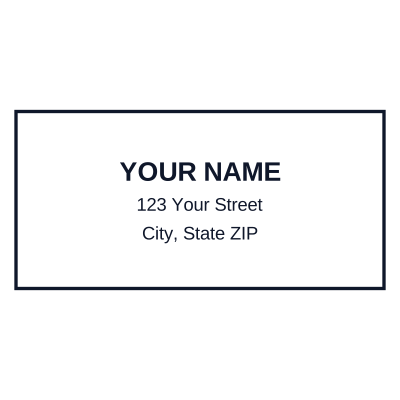
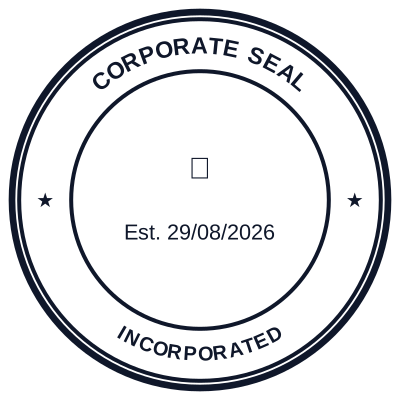

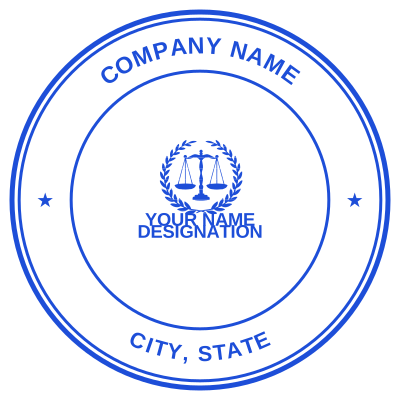

Open the stamp maker with any of these
Every preview on this page carries a faint Estamplab watermark. Your own download does not: the editor renders your stamp again, clean, as a transparent PNG, an SVG or a PDF. See the full template library.
Why make it digitally
- Where a seal is used at all it is usually on share certificates and formal instruments, which are increasingly issued as PDFs.
- UK companies trading with counterparties in Africa, the Gulf or East Asia are regularly asked for a stamp even though their own law does not require one.
- A digital stamp costs nothing to change when the registered office moves, which a cut rubber stamp does.
Questions
Do I need a company seal in the UK?
Almost certainly not. The Companies Act 2006 made the common seal optional, so a UK company can execute documents by signature alone. Where one is still used it is usually because the articles of association require it for a particular instrument, or because an overseas counterparty asks for it. Check your articles, because a provision there binds the company even though the general law does not.
Does a UK company need a company seal?
No. The Companies Act 2006 made the common seal optional, and a document can be executed by signature instead. Check your own articles of association though: they may still say a seal shall be used for particular instruments, and those provisions bind the company regardless of what the general law permits.
What is the difference between a common seal and a company stamp?
The common seal is the formal instrument, historically embossed into the paper to execute a deed. A company stamp is the everyday inked mark showing which company issued a document. The first is a legal formality; the second is evidence.
Why would a UK company still want one?
Mostly because somebody else asks. Overseas counterparties in jurisdictions where seals are expected will often not accept a contract without one, and share certificates traditionally carry one.
Is there a free maker, or only samples?
It is a uk company stamp maker rather than a uk company stamp template you download and then fight with in a word processor. Build a uk company stamp online from a uk company stamp sample, or start empty and use it as a uk company stamp generator: every part of the uk company stamp design stays adjustable. The uk company stamp price covers the file only, $1.50 for a transparent uk company stamp png or $3.00 for every format.
What people call it in the United Kingdom
- rubber stamp the United Kingdom
- The traditional inked die. If you want one made in the United Kingdom, the design is the part worth getting right before you order, because a die is remade from scratch when the wording changes.
- company stamp the United Kingdom
- The workhorse. In the United Kingdom it carries the registered name and number and goes on most outgoing paperwork.
- company seal the United Kingdom
- The more formal version, conventionally round. Whether it is required in the United Kingdom is a separate question from whether a counterparty will ask for one, and the second is what usually decides it.
- common seal the United Kingdom
- The specific legal instrument, historically applied under authority of the board. the United Kingdom is one of the jurisdictions where the phrase is still in everyday use, so the layout is worth getting right.
- stamp maker the United Kingdom
- The tool rather than the shop. Design it in the browser, preview it at actual size, and download it without waiting for anything to be cut or posted to you in the United Kingdom.
- digital stamp
- A stamp that never needs re-inking or reordering. When an address or a registration detail changes in the United Kingdom, you edit it instead of buying a new die.
- round stamp
- Conventionally 38mm to 40mm across. Enough for a ring of text and two or three lines inside it, which is what most marks in the United Kingdom need.
- rectangular stamp
- Use it where the information matters more than the ceremony: addresses, received marks, endorsements, anything with a field to fill in.
- stamp templates
- Sorted by what the mark is for rather than by how it looks, so the set for a company in the United Kingdom is a few clicks rather than a scroll through everything.
- free stamp maker
- You can build the whole thing, look at it at actual size and change your mind as often as you like before paying anything. Priced in USD wherever you are in the United Kingdom.
- putting a stamp on a PDF
- Skips the print, stamp and scan loop entirely. The PDF is processed in your browser, so the document never leaves your machine.
This describes common commercial practice rather than giving legal advice, and practice changes. Where a specific document matters, check the requirement with the body receiving it. Only produce a mark your own organisation is entitled to use.
Other countries
- Company stamp maker for India
- Company stamp maker for the UAE
- Corporate seal maker for the United States
- Company chop maker for China
- Firmenstempel maker for German companies
- Company stamp maker for Dubai
- Company stamp maker for Saudi Arabia
- Company seal maker for Singapore
- Company stamp maker for South Africa
- Company seal maker for Nigeria
- Company seal maker for Australia
- Corporate seal maker for Canada
- Company seal maker for Japan
- Company seal maker for Ireland
- Company stamp maker for France
- Company stamp maker for the Netherlands
- Company stamp maker for Poland
- Company stamp maker for Finland
- Company stamp maker for Spain
- Company stamp maker for Italy
- Company stamp maker for Indonesia
- Company stamp maker for Malaysia
- Company seal maker for the Philippines
- Company seal maker for Thailand
- Company seal maker for Vietnam
- Company seal maker for South Korea
- Company chop maker for Hong Kong
- Company stamp maker for Brazil
- Company stamp maker for Mexico
- Company stamp maker for Turkey
- Company stamp maker for Switzerland
- Company stamp maker for Sweden
- Company seal maker for New Zealand
- Company stamp maker for Portugal
- Company stamp maker for Chile
- Company stamp maker for Morocco
- Company stamp maker for Tunisia
- Company stamp maker for Pakistan
- Company stamp maker for Bangladesh
- Company stamp maker for Egypt
- Company stamp maker for Russia
- Company stamp maker for Ukraine
- Company chop maker for Taiwan
- Company stamp maker for Qatar
- Company stamp maker for Ghana
- Company stamp maker for Kenya
- What a company seal is, and where it is required