Blog › Notary and legal stamps
Company seals: are they still required, and where
12 August 2026 · Estamplab
Make your stamp free · Browse 225 templates
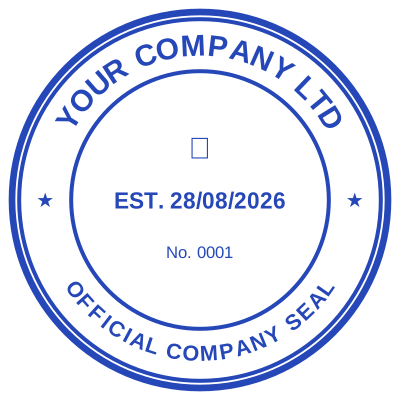

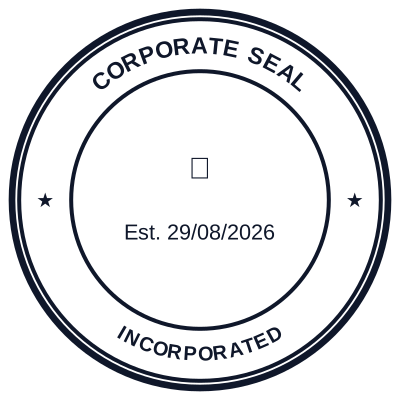
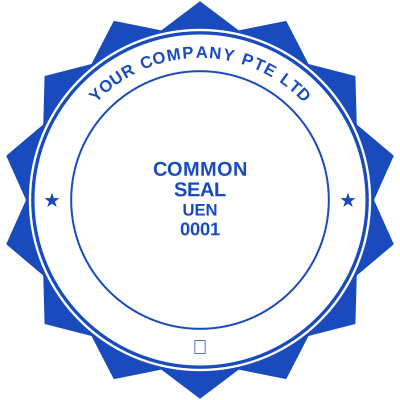


Open the stamp maker and start from any of these
Search whether your company needs a seal and you will get a confident answer. Which answer depends on which country the page was written in, and almost none of them say so.
This is a genuine split, not a matter of opinion, and getting it wrong in either direction costs you: buy a seal you never needed, or send a contract that comes straight back.
What a company seal actually is
A mark carrying a company's registered name, usually curved around a ring, often with the registration number and year of incorporation. Historically it was pressed into the paper. Executing a document "under seal" was a more formal act than signing, and carried more weight.
Note what it is not. A seal does not make a document binding by itself, and in most places a contract is valid on signature alone. The seal is evidence of which company issued the document, not the thing that gives it force.
Where it became optional
United Kingdom. The Companies Act 2006 made the common seal optional. A document can be executed by two directors, or a director and the secretary, or a director whose signature is witnessed. What has not changed is who asks: banks, overseas counterparties, tender portals and registries abroad still expect to see a common seal on documents coming out of a UK company, and a British company trading into Asia, Africa or the Gulf is asked for one routinely.
Australia, New Zealand, Canada, Ireland, Singapore, Hong Kong. Broadly followed, with local variation on execution formalities. A seal is generally permitted and rarely required.
United States. Banks, registries, lenders and title companies ask for a corporate seal often enough that most companies keep one, and the ask usually arrives with a deadline attached. No state requires it to form or run the company, which means nobody hands you one when you incorporate, so the first time it is needed it is needed quickly. That is a different kind of requirement from a statutory one, and just as real when you are standing at the counter.
Where it is still expected
Much of Africa. In Kenya, Nigeria, Ghana, Tanzania, Uganda and others, a company seal on commercial contracts, board resolutions and share certificates remains the norm, and a document arriving without one frequently gets sent back. Whether statute strictly requires it is often beside the point, because the counterparty practice decides.
India and South Asia. Widely expected on share certificates and formal instruments, with the requirement varying by document type and by whether the articles call for it.
The Gulf. Company stamps are near universal on commercial paperwork. An invoice or letter without one often will not be accepted at all.
China, Japan, Korea, Taiwan and much of Southeast Asia. The strongest case anywhere. The company chop is the primary mark of corporate authority, and a contract bearing it can bind the company even without a signature.
That last point deserves emphasis, because Western companies operating in the region regularly miss it. If the chop binds the company, custody of the chop is a governance question, not a stationery one. Whoever holds it can commit the business.
The rule underneath the variation
Two questions decide it, and they are separate:
Does the law require it? Increasingly no, across common-law jurisdictions.
Does the other side expect it? Very often yes, and this is the one that stops your contract.
A seal is cheap and the second question is the one that actually costs you time.
Check your own articles
Even where statute is silent, a company own articles of association may say a seal shall be used for particular instruments and specify who may apply it and whether it must be witnessed. Those provisions bind the company regardless of what the general law permits.
Worth reading before concluding you do not need one.
What should be on it
The short answer is the registered name, the registration number and the year, and there is a fuller company stamp size guide covering the millimetres. If you are still deciding which of the two objects you need, stamp versus seal sets out the difference.
Whether required or merely expected, the usual content is the same: the registered company name exactly as filed, the registration or incorporation number, and often the year of incorporation. Some jurisdictions expect the registered office or the words "Common Seal".
Exactly as filed matters. A seal reading "Estamplab Trading" for a company registered as "Estamplab Trading Limited" invites the objection you made the seal to avoid.
The practical answer
If you trade only in the UK, Australia, Canada or New Zealand and your articles are silent, you probably do not need one.
If you trade with counterparties in Africa, South Asia, the Gulf or East Asia, you will be asked for one, and the question of whether you strictly needed it will not come up in a way that helps you.
This is general information about how company seals are used, not legal advice. Where a specific document matters, check the requirement in the jurisdiction that governs it.
Every kind of stamp and seal
- Notary stamps and seals
- Rubber stamps
- Rubber stamp maker
- Self-inking stamps
- Office stamps
- Official stamps
- Corporate stamps and seals
- Company chops
- Seals for civil servants
- Justice and court stamps
- Legal and advocate stamps
- Certified true copy stamps
- Medical stamps
- Pharmacy stamps
- Veterinary stamps
- Engineer and architect seals
- Land surveyor seals
- Bank stamps
- School and principal stamps
- Teacher and marking stamps
- University and college seals
- Library stamps
- Inspection stamps
- Courier and logistics stamps
- Construction and site stamps
- Real estate stamps
- Hotel and restaurant stamps
- Church and charity seals
- Tender and bid stamps
- HR and payroll stamps
- Received and paid stamps
- Confidential and draft stamps
- Signature stamps
- Date stamps
- Custom band stamps
- Numbering stamps
- Address stamps
- Monogram stamps
- Wedding stamps
- Gift and craft stamps
- Art and logo stamps
- Wax and foil seals
- Stamp or seal, by profession