Blog › Company stamps and seals
Corporate seal or corporate stamp, and the difference
28 August 2026 · Estamplab
Make your stamp free · Browse 225 templates
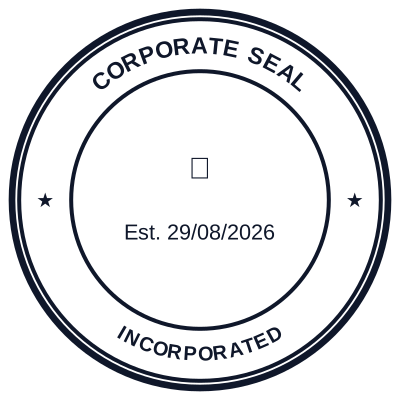



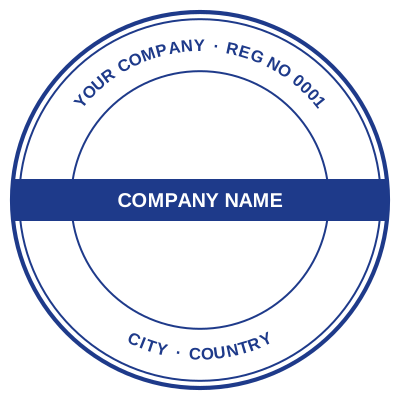
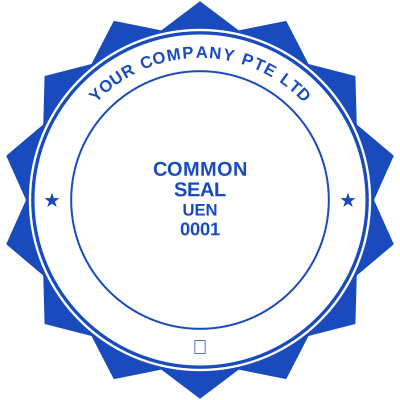
Open the stamp maker and start from any of these
Corporate stamp, corporate seal, common seal and corporate embosser get used as though they were one word. They are four things, and which one you need depends on what the document is doing rather than on how formal you want it to look.
The four, separated
A corporate stamp is an inked mark carrying the company's identity: the registered name, usually the registration number, often the address or town and sometimes a logo. It identifies. It does not execute anything. This is what most businesses mean when they say they need a company stamp, and it is what the corporate stamp maker produces.
A corporate seal is the same information presented as a formal seal: conventionally round, with the name curving around the edge, the year of incorporation or the jurisdiction in the middle. The difference from a corporate stamp is register rather than function. It reads as more formal, and on a certificate or a board document that matters.
A common seal is a specific legal instrument, historically the company's mark for executing deeds, kept in the custody of the secretary and applied under authority of the board. Many jurisdictions have made it optional or abolished the requirement; a few still attach significance to it for particular instruments. Which is which is the subject of is a company seal still required, and the common seal glossary entry has the definition.
A corporate embosser presses the paper between two dies and leaves a raised, colourless impression rather than an inked one. It is tamper-evident because a raised surface cannot be photocopied. It is also invisible on a scan, which is the whole problem with it now: a document that lives as a PDF carries no evidence that it was embossed at all. The embossed seal entry covers that trade-off.
What goes on a corporate stamp
The lines that earn their place, in the order they usually appear:
- The registered name, exactly as registered. Not the trading name, not the shortened one. If the register says "Estamplab Trading Limited", the stamp does not say "Estamplab Trading Ltd". This is the line most often wrong and the one most likely to be checked.
- The company registration number. The single most useful thing on the mark, because it is verifiable in a public register in about a minute. A stamp without it identifies nothing that could not be typed by anybody.
- The jurisdiction or place of incorporation, where the register is national or state-level.
- A tax or VAT registration number, where local practice expects one on commercial documents.
- The registered office town, if there is room.
- A logo, optional, and only if it survives at 38mm. Turning a logo into a stamp knocks the background out so it prints as ink rather than as a white card.
What does not belong: a slogan, a phone number that will change, and anything else you would rather not reprint.
Where each one is used
Corporate stamp, day to day: invoices, quotations, purchase orders, delivery notes, letters, forms submitted to third parties, tender documents, bank correspondence. The bulk of the work.
Corporate seal or common seal: share certificates, board resolutions and minutes, powers of attorney, deeds where the jurisdiction still uses sealing, and anything ceremonial enough that a plain rectangle would look wrong. There are pages for board resolution seal and minutes stamp.
Embosser: certificates and instruments that stay on paper and where tamper evidence is the point. Almost nothing that will be emailed.
Designing one that checks out
The failure mode is not ugliness, it is illegibility of the line that matters.
Set the registration number large enough. It is invariably the smallest text on the mark and the only text anybody verifies. Preview the design at actual size, not at screen size, and if the number is hard to read there, drop something else.
Keep the ring to the name. Curved text is harder to read than straight text. Put the name around the edge and the numbers flat in the middle where they can be read.
Pick the shape for the job. Round for a seal, rectangular for a stamp that has to sit in a margin beside a signature. Stamp shapes and sizes covers the conventions and the standard diameters.
Choose blue or black. Blue is the near-universal default for a business mark, on the reasoning that blue ink on a monochrome photocopy tells you which one is the original. Red is for status marks, not identity.
Pair it with a signature, not instead of one. A corporate stamp beside an authorised signature is a complete mark. A stamp alone on a document that should have been signed is a document that will come back. That pairing is what the signature and company stamp guide is about.
Company forms and their marks
The wording that fits changes with the entity type, and there are pages for each:
- A limited company stamp, the commonest case.
- An LLC stamp, where the suffix and the state matter.
- A partnership stamp, usually carrying the firm name rather than a registration number.
- A sole proprietor stamp, where there may be no registration number at all and the mark carries a trading name.
- A company chop, the square red mark used across East Asia, where the convention is quite different and the chop carries real executing authority.
- A company secretary stamp, for the office rather than the company.
Country conventions differ enough to matter, and there is a page per country under the stamp maker for the major ones. Company stamps around the world covers the differences.
Why the digital version is the one that gets used
A corporate stamp exists to go on documents. Most of a company's documents are now files: the invoice is a PDF, the tender is a PDF, the bank form is a PDF, the letter is an attachment.
A digital corporate stamp goes on all of them directly, from any device, without printing anything. It updates when the registered office changes rather than being reordered. It can carry a date that fills itself in, and a serial number that increments, so a stamped certificate can be tied to one specific issue rather than being one of an indistinguishable set. And it is the same on every machine in the company, which a set of physical dies ordered at different times is not.
Design one in the company seal maker, or start from a template above.
Common questions
What is the difference between a company stamp and a company seal?
The stamp is an inked identity mark used routinely. The seal is the formal instrument, conventionally round and historically used for executing documents. In most jurisdictions today only the first is used regularly, and the second is optional. Stamp vs seal sets it out fully.
Is a corporate seal legally required?
In most jurisdictions, no longer, for most documents. A few still require or expect one for particular instruments. Check the requirement for the specific document rather than assuming either way, and note that a counterparty's own policy often requires one where the law does not.
What should a company stamp include?
Registered name exactly as registered, registration number, and the jurisdiction. Tax number and address where local practice expects them. Nothing that will change soon.
Can a corporate seal be digital?
For identification, yes, and that is what nearly all use of it is. Where a jurisdiction prescribes a physical sealing procedure for a specific instrument, that procedure governs. Are digital stamps legal covers how the electronic records statutes handle this.
Who keeps the company seal?
Traditionally the company secretary, applied under the authority of a board resolution and recorded in a register of sealings. Where a company still has one, that custody discipline is the whole point of it.
Do I need both a stamp and a seal?
Most companies need one identity mark used consistently. A second, more formal version is worth having if you issue certificates or board documents where a plain stamp would look wrong.
Read next: is a company seal still required, and the types of stamp an office needs.
Every kind of stamp and seal
- Notary stamps and seals
- Rubber stamps
- Rubber stamp maker
- Self-inking stamps
- Office stamps
- Official stamps
- Company seals
- Company chops
- Seals for civil servants
- Justice and court stamps
- Legal and advocate stamps
- Certified true copy stamps
- Medical stamps
- Pharmacy stamps
- Veterinary stamps
- Engineer and architect seals
- Land surveyor seals
- Bank stamps
- School and principal stamps
- Teacher and marking stamps
- University and college seals
- Library stamps
- Inspection stamps
- Courier and logistics stamps
- Construction and site stamps
- Real estate stamps
- Hotel and restaurant stamps
- Church and charity seals
- Tender and bid stamps
- HR and payroll stamps
- Received and paid stamps
- Confidential and draft stamps
- Signature stamps
- Date stamps
- Custom band stamps
- Numbering stamps
- Address stamps
- Monogram stamps
- Wedding stamps
- Gift and craft stamps
- Art and logo stamps
- Wax and foil seals
- Stamp or seal, by profession