Blog › Notary and legal stamps
Digital stamp legality
28 August 2026 · Estamplab
Make your stamp free · Browse 225 templates




Open the stamp maker and start from any of these
This is the question people ask before they buy anything, and the answers online are mostly either "yes, totally legal" or "no, you need a wet stamp", neither of which is true as stated. Here is the more useful version.
The short answer
In most places, a stamp on a document has no independent legal force at all. It is evidence, not execution. What makes a contract binding is agreement between the parties; what makes a certification meaningful is that a person with standing certified it. The stamp records that something happened. It is not the thing that happened.
Which means the real question is not "is a digital stamp legal", it is "will this document be accepted by whoever receives it", and that depends on three things: what the law of the relevant jurisdiction says about electronic records, what any specific rule for that document type says, and what the receiving body's own policy is. The third one rejects more documents than the first two combined.
Estamplab is a design tool. This page describes how these rules are generally structured, not what applies to your document. Where a specific document matters, check the requirement with the body receiving it, and take advice where the stakes justify it.
What the electronic records laws actually do
Most jurisdictions now have a statute establishing that a record is not invalid purely because it is electronic. The names differ, the shape is similar.
- In the United States, the ESIGN Act federally, and the Uniform Electronic Transactions Act as adopted by most states, establish that a signature, contract or record may not be denied legal effect solely because it is in electronic form.
- In the European Union, eIDAS does the same and goes further, defining tiers: a simple electronic signature, an advanced electronic signature tied to the signatory and capable of detecting later changes, and a qualified electronic signature backed by a qualified certificate, which carries the equivalent legal effect of a handwritten signature.
- The United Kingdom operates its own retained version of eIDAS alongside the Electronic Communications Act.
- India's Information Technology Act provides for electronic and digital signatures, with digital signature certificates issued by licensed certifying authorities.
- Many other jurisdictions have close equivalents, and several sit inside the UNCITRAL Model Law on Electronic Commerce framework.
The common thread is a principle of non-discrimination: electronic form alone is not a defect. The common exceptions are also similar. Wills, some property instruments, certain family law documents and some court filings are frequently carved out and still require paper, a wet signature, or both.
Note what these laws are about. They are about signatures and records, not about stamps. A stamp attached to an electronic record inherits the record's status; it does not get its own.
Where a stamp does carry weight
There are settings where the mark itself is prescribed rather than decorative, and in those the rules are specific and local.
- Notarial acts. Whether an electronic or remote notarisation is permitted, and what form the notarial mark must take, is set by the commissioning jurisdiction. Some permit it with detailed requirements. Some do not. The notary stamp guide covers what goes on the mark.
- Company seals. A handful of jurisdictions still attach formal significance to a common seal for particular instruments, though most have made it optional. We went through which ones in is a company seal still required.
- Professional certifications. An engineer's, architect's or surveyor's seal is regulated by the licensing board, and several boards now specify exactly how a digital seal must be applied and secured.
- Revenue and duty stamps. A stamp duty mark is a tax record, and a physical or officially issued electronic one, not a design you make.
If your document is in one of those categories, the answer comes from the regulator, not from a general electronic records statute.
What makes a stamped file hold up in practice
Whatever the jurisdiction, a document is stronger for a few things that are entirely within your control.
Put the date on the mark. An undated stamp says something happened. A dated one says when. On a received or approved mark that is most of the value, and a date on the stamp is far harder to argue with than a date typed elsewhere on the page. The date stamp generator sets it as an editable field.
Number the impressions. A serial number on the mark ties an individual impression to an individual document, so a stamped page cannot be quietly swapped for another one bearing the same generic mark. This is the single strongest thing you can add and almost nobody does it. It is the whole subject of serial numbers on stamps.
Keep the stamp legible. A mark that cannot be read cannot be relied on. Preview at actual size and check the registration number.
Flatten the file. A stamp placed as a movable annotation in a PDF viewer can be dragged off by the next person to open it. A stamp composited into the page cannot. The stamp on a PDF tool writes it into the page content.
Sign the document if it matters. This is the important one. A stamp is a mark; a cryptographic signature is a mathematical binding between a document, a key and a moment in time, and it is what actually detects a later alteration. Where the stakes are real, the stamp is the visible convention and the signature is the control. They do different jobs and a serious workflow uses both.
Types of stamp and where each sits
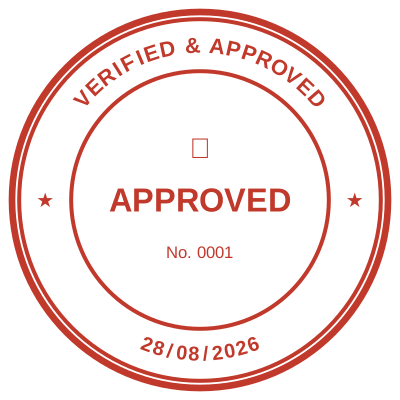
- An electronic seal or e-stamp as a visual mark, which is what this site makes.
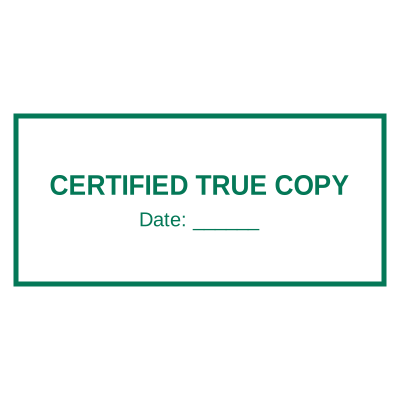
- A certified true copy stamp mark, where a person is attesting that a copy matches an original. The attestation is the person's, and it carries whatever weight that person's standing gives it.
- A company stamp, which in most jurisdictions is an identification convention rather than an execution requirement.
- Status marks like DRAFT, COPY and VOID, which are internal controls and carry no legal machinery at all. They still prevent expensive mistakes.
Common questions
Is a digital stamp as valid as a rubber stamp?
Generally yes, in the sense that neither has independent legal force and both are evidence of the same kind. A digital one is usually better evidence, because it can carry a date and a serial that a rubber die cannot.
Will a court accept a digitally stamped document?
Courts accept electronic records routinely, and the electronic records statutes above exist to make that clear. Admissibility turns on authenticity and provenance rather than on whether the mark was ink or pixels. That is an argument for dating, numbering and flattening, and for a real signature where the amount at stake justifies one.
Do I need a qualified electronic signature?
Only if the jurisdiction or the counterparty requires one. Under eIDAS a qualified signature carries the strongest presumption, and some regulated transactions specify it. Most commercial paperwork does not.
Can I use a digital company stamp on an invoice?
Almost universally yes. Invoices are among the least regulated documents a business issues, and stamping them is convention rather than requirement.
Is it legal to make a stamp with my own company name on it?
Yes. It is your name. What is not legal anywhere is making a mark that impersonates another organisation, a public body, a regulator or a professional whose credentials you do not hold. That line is worth knowing precisely, and it is covered in how to spot a fake stamp.
Read next: serial numbers on stamps, and is a company seal still required.
Every kind of stamp and seal
- Notary stamps and seals
- Rubber stamps
- Rubber stamp maker
- Self-inking stamps
- Office stamps
- Official stamps
- Company seals
- Corporate stamps and seals
- Company chops
- Seals for civil servants
- Justice and court stamps
- Legal and advocate stamps
- Certified true copy stamps
- Medical stamps
- Pharmacy stamps
- Veterinary stamps
- Engineer and architect seals
- Land surveyor seals
- Bank stamps
- School and principal stamps
- Teacher and marking stamps
- University and college seals
- Library stamps
- Inspection stamps
- Courier and logistics stamps
- Construction and site stamps
- Real estate stamps
- Hotel and restaurant stamps
- Church and charity seals
- Tender and bid stamps
- HR and payroll stamps
- Received and paid stamps
- Confidential and draft stamps
- Signature stamps
- Date stamps
- Custom band stamps
- Numbering stamps
- Address stamps
- Monogram stamps
- Wedding stamps
- Gift and craft stamps
- Art and logo stamps
- Wax and foil seals
- Stamp or seal, by profession