Blog › Notary and legal stamps
Lawyer digital stamps
21 August 2026 · Estamplab
Make your stamp free · Browse 225 templates


Open the stamp maker and start from any of these
A law practice does not need a stamp. It needs six or seven, each doing a different job, and the day one of them is in a drawer twelve miles away is the day a filing is late.
This is about three things: which marks a practice actually uses, why numbering each impression against a matter closes a billing leak most firms never see, and how to apply a stamp to a document in Microsoft Word on a phone when you are at court, at a client's office, or at home at nine on a Sunday night.
One thing first, because everything below depends on it. A stamp is a mark of authorship, not proof of identity. It says this came from this practice. It does not verify who pressed it, and no digital stamp changes that, ours included. Where a document has to be proved rather than marked, the answer is the receiving body's own process, not a better seal. The rest of this assumes you are making your own practice's marks for your own use.
The stamps a legal practice actually uses
Ask a firm how many stamps it owns and the answer is usually "a couple". Ask what gets stamped in a week and the list runs longer.
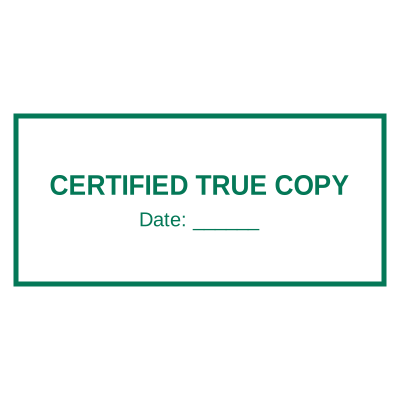
The certified true copy stamp. The workhorse. Passports, title deeds, certificates, board resolutions, anything a client brings in as an original and needs to leave as a copy that another party will accept. This one is used more than the rest combined in most practices, and it is the one that needs a date on every single impression.
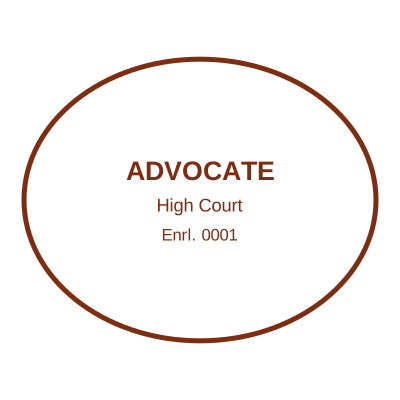
The advocate or attorney seal. The practitioner's own professional mark, usually carrying the name, the admission or enrolment number, and the court or roll. One per fee earner, not one per firm, which is exactly why the shared block in reception is the wrong model.
The notarial seal, for practices with a notary. Distinct from the advocate seal, distinct in what it attests, and in most jurisdictions the form is prescribed rather than chosen.
The firm's common seal or company chop, where the practice is itself a company executing its own documents, and where the jurisdiction still gives the seal weight. Whether one is still required at all is a separate question, and we have written about whether a company seal is still required.
The received and date-stamped mark. Not glamorous and the one that gets litigated. When a document arrived is the whole argument in a limitation dispute, and a received stamp with a wrong or absent date is worse than no stamp, because it looks like a record. If yours is a rotating date band, it is probably showing the wrong date right now.
The exhibit stamp. "This is the exhibit marked A referred to in the affidavit of ___ sworn on ___". Blanks that a person fills in, every time, per exhibit. A bundle of forty exhibits is forty impressions.
Sworn, witnessed and jurat marks. Sworn to before me, witnessed by, signature and date rules that get written on rather than printed.
That is seven distinct marks before anyone has ordered a second one for a second office. Physically that is a drawer of rubber, a reorder cycle every time a name or a number changes, and a governance problem about who holds which one. As files it is seven images that cost nothing to hold and can be reissued the same afternoon a partner's enrolment number changes.
Numbering an impression to a matter, and the leak it closes
Here is the part firms underrate.
Certification work is real work. Someone takes the original, compares it to the copy line by line, satisfies themselves it is a true copy, applies the mark, and takes on professional responsibility for having done so. In most practices it is recorded nowhere. It happens at a counter, between other things, and the file note that would have made it billable never gets written. Multiply an unrecorded five minutes by every certification a busy practice does in a month and the number stops being trivial.
The leak is not that the work is unpriced. It is that the work is invisible. You cannot bill, audit, or defend something you have no record of.
A serial number changes what an impression is. Instead of an interchangeable mark that says "some copy, certified by us, some time", each one carries a unique number, and that number can be written into the matter file the moment it is issued. Now the certification is an event with an identifier. It can be listed on the bill. It can be counted at month end. And when a client rings eighteen months later asking whether you certified a particular deed, you have an answer instead of a recollection.
Two honest limits on that.
The number only means something if it is genuinely never issued twice, which needs a counter that is safe when two people are working at once, not a local count on somebody's laptop. That is a real engineering problem and we have written about the three ways serial numbers usually break.
And numbering is not matter management. The software issues a number that is unique; connecting it to a file is still a person writing it down at the point of issue. What the number does is make that a five second entry with something specific to enter, rather than a note somebody meant to write.
In Estamplab you get both routes. Sign in, tick "Number this one", and each download takes the next number in that stamp's sequence. Or type the number yourself, which is what you want when the identifier that matters is your own matter reference rather than a running count. A stamp reading "CTC/2026/0412" on a certified copy is worth more to a practice than "No. 0007", because it points at a file.
The reputation argument
A wrong date on a received stamp, a certification nobody can evidence, an advocate seal still carrying an enrolment number that changed two years ago, a copy that was never actually checked against its original. None of these are dramatic. All of them are the kind of thing that surfaces at the worst possible moment, in front of the one counterparty you did not want to explain yourself to.
Marks that carry an accurate date, a number that traces back to a file, and details that are current because updating them takes a minute rather than a fortnight, are quietly a professional standards control. Not because the stamp proves anything. Because the practice around it is evidenced.
Working from a phone, and the trip you stop making
The physical version of all this has a geography problem. The stamp is in the office. You are not.
Court rises at three, a client needs a certified copy by five, and the block that would do it is in a drawer across town. So you drive back. Or a filing needs the firm's mark on a Sunday and there is no version of that which does not involve a car.
The cost of that trip is not just fuel. It is the fuel, plus the hour, plus the hour being a chargeable hour you did not charge. Put your own numbers in; the fuel is usually the smallest of the three.
A stamp that is a file removes the trip rather than shortening it. Here is the phone version, start to finish:
- Open the stamp maker in your phone's browser. There is nothing to install, and the design saves as you go.
- Pick the mark you need, set the date or leave a blank to write on, and download it. On a phone the transparent PNG is the reliable choice; it lands in Files or Downloads like anything else.
- Open the document in Microsoft Word on the phone, tap Insert, then Pictures, and place the stamp.
- Set the wrapping so it sits over the text rather than inside the paragraph. This is the step people miss on every device, and we have written it out properly in how to insert a stamp in Word.
If you downloaded the Word file rather than the image, the floating layout is stored inside the .docx itself rather than applied by the app, so it survives being opened on a phone. Word's mobile apps give you fewer layout controls than the desktop, so for a document you are building from scratch the desktop is still easier. For dropping a certified copy mark onto something and sending it, the phone is enough.
Two practical notes. Use the transparent PNG, never a JPG, because JPG has no transparency at all and every non-ink pixel is stored as literal white, which is where the white box behind a stamp comes from. And if a document is going to be printed, stamped by hand, scanned and emailed back, the stamp was the least of what you lost; that loop costs more than the paper.
What this does not do
It does not make a document harder to forge. A digital stamp is an image, and an image copies. Going digital moves the control from physical custody of a rubber block to control of an account, which is a real improvement in some ways and a different exposure in others, and we set that out plainly in the problems with physical stamps.
It does not replace a prescribed form. Where a notarial or court-prescribed seal has a required shape, wording or method of application, that requirement governs, and it varies enormously by jurisdiction. Check what applies where you practise.
It does not certify anything. The certification is the act of comparing the copy to the original and taking responsibility for it. The mark records that you did. It cannot do it for you.
The short version
A practice needs a set of marks, not a stamp. Numbering each impression against a matter turns certification work from something that happens into something you have a record of, which is the difference between billing it and losing it. And a mark that lives in a file rather than a drawer is available at court, at a client's table, and on a Sunday, which is worth more over a year than the fuel it saves.
Design any of them free, no account, and see the finished mark at full size before paying anything: open the stamp maker.
This describes common practice and is not legal advice. Requirements differ by jurisdiction and by receiving body; where a specific document matters, confirm the requirement with whoever will receive it.
A closing note. This is a design tool and the page describes how practices organise their marks rather than advising on what any court or bar requires: those rules are set by them and differ by jurisdiction. Only produce a seal for an admission you actually hold, because a mark carrying somebody else's practising number is forgery.
Every kind of stamp and seal
- Notary stamps and seals
- Rubber stamps
- Rubber stamp maker
- Self-inking stamps
- Office stamps
- Official stamps
- Company seals
- Corporate stamps and seals
- Company chops
- Seals for civil servants
- Justice and court stamps
- Certified true copy stamps
- Medical stamps
- Pharmacy stamps
- Veterinary stamps
- Engineer and architect seals
- Land surveyor seals
- Bank stamps
- School and principal stamps
- Teacher and marking stamps
- University and college seals
- Library stamps
- Inspection stamps
- Courier and logistics stamps
- Construction and site stamps
- Real estate stamps
- Hotel and restaurant stamps
- Church and charity seals
- Tender and bid stamps
- HR and payroll stamps
- Received and paid stamps
- Confidential and draft stamps
- Signature stamps
- Date stamps
- Custom band stamps
- Numbering stamps
- Address stamps
- Monogram stamps
- Wedding stamps
- Gift and craft stamps
- Art and logo stamps
- Wax and foil seals
- Stamp or seal, by profession