Bank stamps, and what an endorsement stamp does
28 August 2026 · Estamplab
Make your stamp free · Browse 225 templates
Open the stamp maker and start from any of these
Bank marks are the most functional stamps there are. None of them are decorative. Each one changes what can be done with the piece of paper it is on, or records that something happened to it, and getting the wording wrong has consequences that are financial rather than cosmetic.
The restrictive endorsement: For Deposit Only
The single most useful bank stamp a business can own.
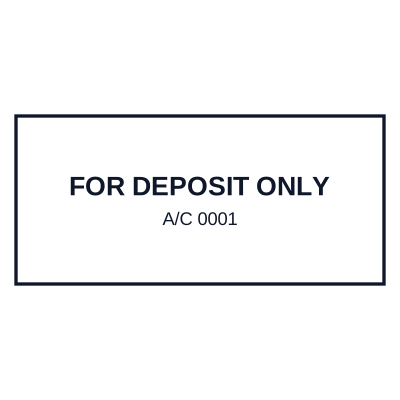
A cheque made out to your business is, until it is endorsed, a fairly loose instrument. Endorsing the back of it For Deposit Only, with the account name and number, restricts it: the cheque can now only be paid into that account. If it is lost, stolen or handled by somebody who should not be handling it, it cannot simply be cashed.
The mark itself is plain. Three or four lines, rectangular, on the endorsement area on the reverse:
FOR DEPOSIT ONLY
ESTAMPLAB TRADING LIMITED
A/C 0123456789
FIRST NATIONAL BANK
The discipline is that the stamp goes on the moment the cheque is opened, not when somebody gets round to the banking run. A drawer of unendorsed cheques is an unlocked drawer. There is a page for the layout at For Deposit Only stamp and a product page at deposit only stamp.
Endorsement stamps generally
A restrictive endorsement is one kind. The others:
- A blank endorsement is just a signature, and it makes the cheque payable to whoever holds it. It is the least safe thing you can do to a cheque and should never be a stamp.
- A special endorsement pays the cheque to a named third party: "Pay to the order of ...".
- A restrictive endorsement, as above, limits how it can be dealt with.
Endorsement stamps usually carry the account number precisely so that a cheque can be traced afterwards. If a payment goes astray, the endorsement is how you establish which account it was routed to and when. That traceability is the point, and it is the same argument as for serial numbers on stamps in other settings.
Bank-side marks
From the other side of the counter, several marks are doing bookkeeping rather than instruction.
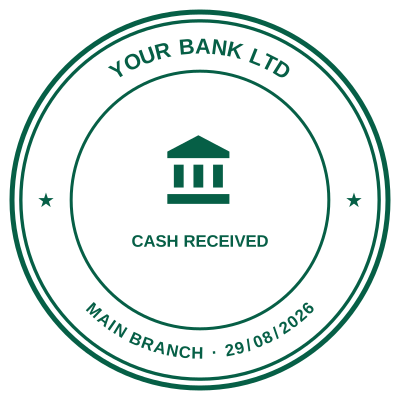
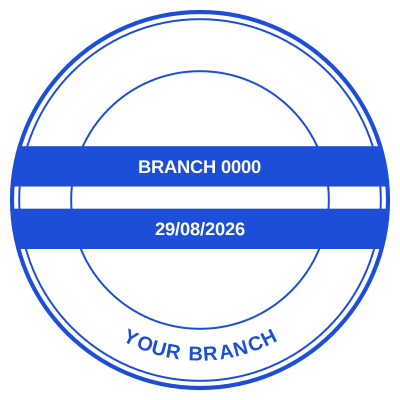
A bank stamp or branch stamp carries the bank name, the branch and often the branch code, and goes on anything the branch has handled: a paying-in slip, a certified copy of a statement, a letter confirming a balance.
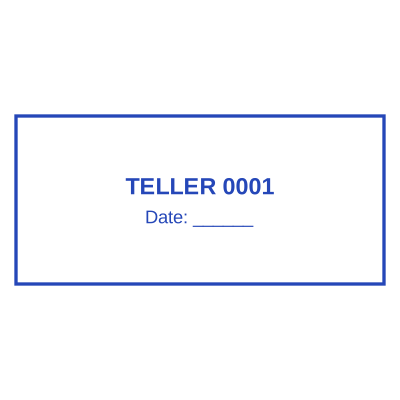
A teller stamp identifies which counter position processed a transaction, usually with a teller number and the date, so a day's work can be reconciled back to a person.
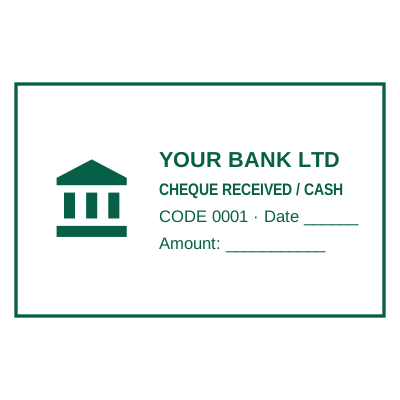
A received or cheque-received mark logs that an instrument arrived, with the date. On a finance desk that is the difference between "we never got it" and a dated entry.
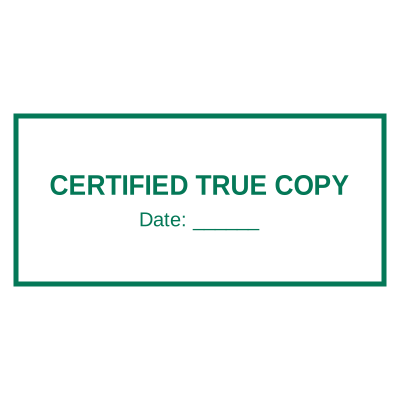
A certified true copy mark is the one that travels furthest outside the bank: a copy of a passport, a statement or a certificate that somebody has physically compared against the original and is taking responsibility for. There is a whole page on that mark and its wording, because it is the one people most often use without understanding what they are attesting.
The finance desk set
Beyond the bank itself, the marks a payables or receivables desk actually uses:
- PAID, on the invoice, the moment it is settled. Combined with a date, it stops the same invoice being paid twice, which is a more common loss than most businesses admit. The paid stamp generator with date sets both in one mark.
- RECEIVED with the date, on anything logged in.
- CHECKED or APPROVED, for the sign-off step before payment.
- VOID on a spoiled cheque or a cancelled instrument, so it cannot re-enter the process.
- A receipt stamp with an incrementing number, where receipts have to be accounted for in sequence.
The last one is worth pausing on. If your receipts are numbered by hand, the numbers will eventually collide or skip, and a gap in a receipt sequence is exactly what an auditor asks about. An auto-numbering stamp increments on its own, and a digital one does it without a mechanical counter to jam.
Doing this digitally
Cheque endorsement is paper, and stays paper. Most of the rest of it is not any more.
Remittance advices, invoices, statements and confirmations arrive as PDFs, and the mark that goes on them is a PNG with a real alpha channel placed on the page rather than an inked die pressed onto it. It is faster, it is legible on the file everybody actually keeps, and it does not need a print-and-scan loop that costs more than people think. We did the arithmetic on that in the paper a stamp costs.
The one rule worth keeping: a bank mark on a digital document should carry the same information the physical one would, including the date. A dated PAID mark is evidence. An undated one is decoration.
Worth saying plainly: this is a design tool and describes common commercial practice, not advice on what any specific document requires. Banks, registries and counterparties each set their own requirements and they differ between countries, so check with whoever will receive the document. And only make a mark for a business you are entitled to represent, because a stamp in another organisation's name is forgery whatever it was made with.
Common questions
Is a For Deposit Only stamp legally required?
No, it is a precaution rather than a requirement. It is a cheap one: the endorsement restricts what can be done with a cheque that leaves your control, and the stamp costs less than one recovered payment.
What should a For Deposit Only stamp say?
The restriction itself, the account name as the bank holds it, the account number, and usually the bank or branch. Keep it to four lines. Anything longer will not fit the endorsement area cleanly.
Can I put a bank stamp on a PDF?
Yes. Design the mark, download the transparent PNG, and place it on the page. If you would rather not leave the browser, the stamp on a PDF tool does it here. What you cannot do is stamp a cheque digitally, because a cheque is the physical instrument.
What is the difference between a bank stamp and a teller stamp?
The bank stamp identifies the institution and branch. The teller stamp identifies the counter position and the person, so the day's transactions reconcile back to who processed them.
How do I make a bank stamp online?
Open the bank stamp maker, set the bank name, branch and any code, and download it. For an endorsement, start from the For Deposit Only stamp layout, which is already sized for the endorsement area.
Read next: the types of stamp an office needs, and serial numbers on stamps.
Every kind of stamp and seal
- Notary stamps and seals
- Rubber stamps
- Rubber stamp maker
- Self-inking stamps
- Office stamps
- Official stamps
- Company seals
- Corporate stamps and seals
- Company chops
- Seals for civil servants
- Justice and court stamps
- Legal and advocate stamps
- Certified true copy stamps
- Medical stamps
- Pharmacy stamps
- Veterinary stamps
- Engineer and architect seals
- Land surveyor seals
- School and principal stamps
- Teacher and marking stamps
- University and college seals
- Library stamps
- Inspection stamps
- Courier and logistics stamps
- Construction and site stamps
- Real estate stamps
- Hotel and restaurant stamps
- Church and charity seals
- Tender and bid stamps
- HR and payroll stamps
- Received and paid stamps
- Confidential and draft stamps
- Signature stamps
- Date stamps
- Custom band stamps
- Numbering stamps
- Address stamps
- Monogram stamps
- Wedding stamps
- Gift and craft stamps
- Art and logo stamps
- Wax and foil seals
- Stamp or seal, by profession