Rubber stamps explained: the types and the parts
28 August 2026 · Estamplab
Make your stamp free · Browse 225 templates





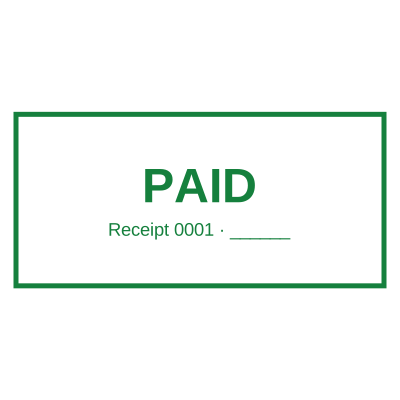
Open the stamp maker and start from any of these
"Rubber stamp" covers three quite different objects. They have different mechanisms, different costs and different ways of going wrong, and the shop selling you one will not usually explain which you are getting. This is the whole picture, including the parts nobody names, and the case for not buying one at all.
The three kinds
Before the mechanisms, the bodies, because a shop will offer you all of these and the words are not interchangeable. A wooden stamp is a laser-engraved or moulded die on a wooden handle: the cheapest, the most durable, and the one that needs a separate ink pad. A clear stamp is a die of transparent polymer on an acrylic block, and the point of the acrylic is that you can see through it and place the impression exactly, which is why crafters and anybody stamping onto a printed layout use them. A band stamp carries rotating rubber bands of letters or numbers, so one stamp prints many values, which is what a date stamp is underneath. Then the two mechanisms below.
Wood handle stamps
The traditional thing: a rubber die glued to a wooden mount with a handle on top, used with a separate ink pad. No mechanism at all.
They are the cheapest, they last essentially forever, and they give you complete control over ink because the pad is a separate object you can swap for any colour. They are also the slowest, because every impression is two motions: pad, then paper.
Still the right choice for craft work, for large marks that no self-inking housing is made for, and for anyone who wants a mark that looks hand-applied.
Self-inking stamps
A rubber die in a spring housing with the ink pad built in. Press down, the die flips onto the pad, inks itself and prints. Release, it flips back.
The default office stamp, and the right default. One motion per impression, roughly 5,000 to 10,000 impressions before the pad needs re-inking, and a pad that can be replaced or re-inked in any colour. This is also the only mechanism that can carry a rotating date band, which is why every self-inking date stamp is self-inking.
Pre-inked stamps
No pad. The ink is held inside a sealed porous die and weeps out through the design as you press.
Much sharper impressions, 20,000 to 50,000 before a refill, and silent. Costs more, and the colour is fixed at manufacture because the ink is inside the die. The full comparison is in self-inking vs pre-inked stamps.
The parts, named
Useful when something goes wrong and you have to describe it.
- The die is the rubber (or photopolymer) piece carrying your design in reverse. It is the part that gets remade when your details change.
- The mount is what the die is fixed to: wood, plastic, or the moving plate inside a self-inking housing.
- The die plate on some self-inking models is a removable cartridge, so a text change replaces the plate rather than the whole stamp. Worth asking about before you buy.
- The pad is the felt or foam ink reservoir. It is a consumable. Replacement pads are cheap and sold by model number, which is printed on the housing.
- The housing is the spring mechanism and body. It outlasts everything else.
- The ink is not one thing. Standard water-based ink is fine on paper and useless on plastic or foil. Quick-dry ink stops the smear when a stamped page goes straight into a pile. Permanent and solvent inks mark non-porous surfaces. Fabric ink is a different chemistry again.
Custom rubber stamps: what to send
Whether you are ordering a block or making a custom stamp online, the artwork question is the same one, and it is the part that decides how the impression reads.
If you are ordering a custom rubber stamp, the file you send determines the die you get back.
Send vector artwork: an SVG or a vector PDF. Vector describes the design as outlines, so it scales to die size cleanly and the laser or plotter follows the paths exactly. A PNG or a photo describes it as pixels, and at 38mm those pixels are visible steps on every curve.
Design it here, download the SVG, send that. Whichever of the three manufacturing methods the shop uses, and they are covered in how rubber stamps are actually made, all of them prefer it.
Two layout constraints come straight from the manufacturing rather than from taste. Keep strokes above about a quarter of a millimetre at final size, or they fill in or break off. And leave space between elements, because ink spreads slightly on paper and a crowded design bridges into itself after a few hundred impressions.
What people actually buy
The marks that turn up on nearly every order:
- A company stamp with the registered name and number.
- A date stamp, usually combined with RECEIVED or PAID.
- An address stamp for envelopes and forms.
- A signature stamp for routine sign-offs.
- Status marks: APPROVED, DRAFT, CONFIDENTIAL, COPY, VOID, URGENT.
- A logo stamp, where the mark is the brand rather than the text.
The set a small business needs is narrower than the catalogue suggests, and we went through it in the four stamps every small business needs.
Read more: Self-inking vs pre-inked stamps, and where a digital one beats both
Where the rubber stops making sense
A physical stamp works on paper in the room you are standing in. That describes less office work every year.
An invoice emailed as a PDF, a contract circulated as an attachment, a certificate scanned and sent, a form completed on a phone at a client's premises: none of those can be stamped with rubber without printing the file, stamping it and scanning it back, which degrades the document at every step and costs more than people realise. We put numbers on that loop in the paper a stamp costs.
A digital version of the same mark is a PNG that behaves like ink on paper placed on the page. Same design, no pad, no reorder when the address changes, no lead time, and it works from a phone. It also does two things rubber cannot: fill in the date automatically, and carry a serial number that increments so each impression is distinguishable.
Design yours in the rubber stamp maker, and if you also want the physical one, take the SVG to a shop.
Common questions
How much does a custom rubber stamp cost?
Individually, not much. The cost that surprises people is the reordering: every address change, registration renewal or personnel change makes a set of dies obsolete at once. What a rubber stamp actually costs does the arithmetic.
How do I re-ink a rubber stamp?
For a self-inking stamp, open the housing, lift the pad out, run a few drops of matching ink along it and leave it a few minutes. Do not flood it: an over-inked pad smears for the next fifty impressions. For a wood handle stamp, ink the pad the same way. A pre-inked stamp takes a refill through a port, and only its own ink.
How do I clean a rubber stamp?
A damp cloth on the die face, then blot dry. Never solvent, which perishes rubber. Blurring is usually too much ink or dust in the pad, not a worn die.
Can I change the text on a rubber stamp?
Only if the model takes a replaceable die plate, and even then it is a reorder with a lead time. This is the difference that matters most in practice: a digital stamp is edited in place in seconds.
What is the best size for a rubber stamp?
38mm or 40mm for a round mark, about 55mm by 20mm for a rectangular one. Stamp shapes and sizes covers what fits in each.
Can I make a rubber stamp at home?
You can carve one from lino or an eraser block, and for craft work it is genuinely good. It will not hold the fine detail a business mark needs, and a hand-carved registration number will not read.
Read next: self-inking vs pre-inked stamps, and how rubber stamps are actually made.
Every kind of stamp and seal
- Notary stamps and seals
- Rubber stamp maker
- Self-inking stamps
- Office stamps
- Official stamps
- Company seals
- Corporate stamps and seals
- Company chops
- Seals for civil servants
- Justice and court stamps
- Legal and advocate stamps
- Certified true copy stamps
- Medical stamps
- Pharmacy stamps
- Veterinary stamps
- Engineer and architect seals
- Land surveyor seals
- Bank stamps
- School and principal stamps
- Teacher and marking stamps
- University and college seals
- Library stamps
- Inspection stamps
- Courier and logistics stamps
- Construction and site stamps
- Real estate stamps
- Hotel and restaurant stamps
- Church and charity seals
- Tender and bid stamps
- HR and payroll stamps
- Received and paid stamps
- Confidential and draft stamps
- Signature stamps
- Date stamps
- Custom band stamps
- Numbering stamps
- Address stamps
- Monogram stamps
- Wedding stamps
- Gift and craft stamps
- Art and logo stamps
- Wax and foil seals
- Stamp or seal, by profession