Self inking stamps against pre-inked ones, compared
28 August 2026 · Estamplab
Make your stamp free · Browse 225 templates
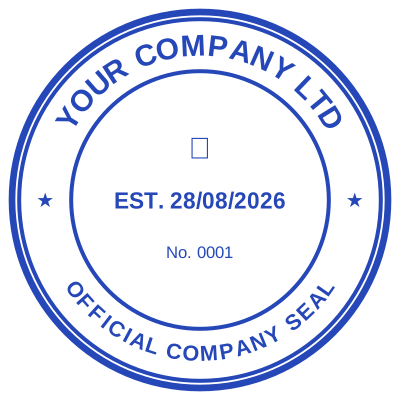

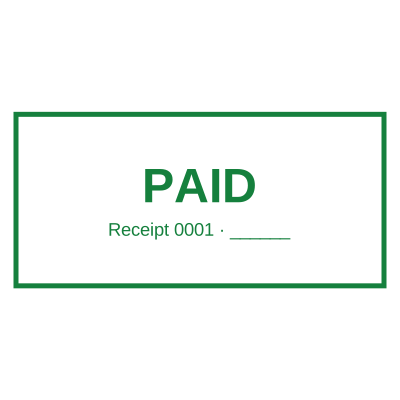


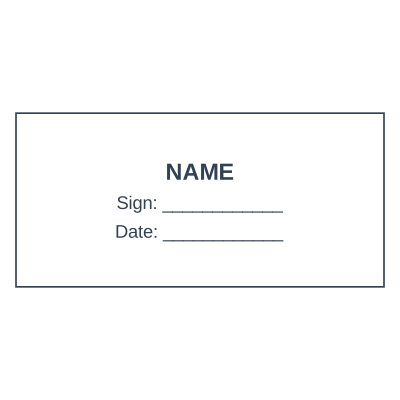
Open the stamp maker and start from any of these
If you are buying a physical rubber stamp, the choice is almost always between a self-inking stamp and a pre-inked one. They look similar in a catalogue and behave very differently on a desk. Here is what actually separates them, and the case where neither is what you want.
The short answer
A self-inking stamp carries a rubber die and a separate ink pad in a spring housing. Press it, the die swings onto the pad, inks itself and prints. A pre-inked stamp has no pad at all: the ink lives inside the die itself, in a porous material that weeps ink through the raised areas as you press.
Self-inking is cheaper, takes any ink colour and is easy to re-ink. Pre-inked gives a sharper, more even impression and lasts far longer between refills, but costs more and is fussier about colour changes.
If the stamp is going onto a PDF, a Word file or an email attachment rather than paper, neither mechanism matters and you want a digital stamp instead. That is the case at the bottom of this page.
Impressions per refill
This is the number that decides it for most buyers.
A self-inking stamp gives roughly 5,000 to 10,000 impressions before the pad needs re-inking, and re-inking is a two minute job with a bottle. A pre-inked stamp gives something like 20,000 to 50,000 before it needs a refill, because the reservoir is the die.
If you stamp a dozen documents a week, both will outlive the business. If you are stamping a stack of invoices every morning, the difference is real, and so is the fatigue: a self-inking mechanism has a spring you are compressing on every press.
Image detail
Pre-inked wins here and it is not close.
A self-inking die is moulded rubber pressed against a felt pad, so the impression carries a little of the pad's texture and a little ink spread at the edges. Fine serif text at the small end, hairline borders and detailed logos all soften.
A pre-inked die is a much finer porous material, and the ink comes through the surface rather than being picked up off one. The impression is crisper and more uniform, which matters if your design carries a registration number, a small licence line or an intricate logo stamp.
The practical rule on a self-inking stamp: keep the design simple. Too many elements crowded into 38mm and the impression blotches, which is the same advice that applies to any custom rubber stamp.
Ink colour
Self-inking is flexible. The pad is a consumable, so a black pad becomes a red one for the price of a new pad, and multi-colour pads exist where different bands of the design print in different colours.
Pre-inked is not. The ink is in the die. Changing colour means a new die, and re-inking with the wrong colour ruins the one you have. Choose the colour at the point of order and expect to keep it.
Blue is the default for a business stamp in most of the world, on the reasoning that blue ink on a black-and-white photocopy tells you instantly which one is the original. Red is conventional for status marks like VOID, PAID and URGENT, and for the red stamp look generally. Black reads as formal and is common on legal and notarial work.
Cost
A self-inking stamp costs less to buy and less to maintain in small quantities. A pre-inked stamp costs more up front and less per impression at volume.
Neither is expensive on its own. What gets expensive is the number of them: a business with six branches and four stamp types each is ordering 24 dies, and every name change, address change or registration renewal reorders the lot. We put real numbers on that in what a rubber stamp actually costs.
Which mechanism suits which stamp
- Date stamps work best self-inking, because the movable bands have to rotate and a pre-inked die cannot carry them. See the self-inking date stamp page for the layout.
- Signature stamps favour pre-inked. A signature is fine detail and a self-inking pad thickens it until it stops looking like the signature.
- High-volume status marks (RECEIVED, PAID, POSTED) favour pre-inked purely on refills.
- Company stamps go either way. If the design carries a registration number in small type, lean pre-inked.
- Notary and professional seals are usually a third thing entirely, an embossed seal that presses the paper rather than inking it.
Where a digital stamp beats both
Everything above is a discussion about ink getting onto paper. A large and growing share of the documents that need a stamp never touch paper: a PDF invoice, a scanned certificate, a contract circulated as an attachment, a form filled in on a phone.
For those, the mechanism question disappears. A digital stamp is a background-free PNG or an SVG that sits on the page as ink, with no pad, no refill and no reorder when the address changes. It never runs dry mid-stack, it is the same on every device, and it costs nothing to keep a dozen variants of.
It also does something a physical stamp cannot: carry a serial number that increments on its own, so every impression is distinguishable from the last. That is the whole subject of serial numbers on stamps.
Start from a design rather than a blank canvas:
Two things this page is not. It is a description of what these marks are and how they are laid out, not advice on when one is legally required: that is set by the body receiving the document and it differs by country. And a design tool makes the mark, not the standing behind it, so only ever produce a stamp you are entitled to use.
Common questions
Can you refill a self-inking stamp?
Yes. Open the housing, lift out the pad, apply a few drops of the matching ink along it and let it sit for a few minutes before the next impression. Do not flood it: an over-inked pad produces a smeared, blotchy print for the next fifty stamps.
Can you change the text on a self-inking stamp?
Not usually. The die is moulded for that text. Some models take a replaceable die plate, so the housing is reused and only the rubber is remade, which is cheaper than a new stamp but still a reorder with a lead time. A digital stamp is edited in place, which is the practical difference.
How long does a rubber stamp last?
The housing usually outlasts the business. The die wears slowly and the ink is the consumable. Realistically what kills a stamp is not wear, it is a change: a new address, a new registration number, a rebrand, a director leaving.
Which is better for a company stamp?
For a straightforward name-and-registration-number company stamp, self-inking is the normal choice and perfectly good. Go pre-inked if the design has fine detail or you stamp in volume. And keep a digital version regardless, because most of what you stamp now is a file.
How do I clean a rubber stamp?
A damp cloth on the die face, blotted dry, and never solvent, which perishes rubber. If the impression is blurring, the usual cause is dust in the ink rather than a worn die.
Read next: the types of stamp an office actually needs, and how to put a stamp on a PDF.
Every kind of stamp and seal
- Notary stamps and seals
- Rubber stamps
- Rubber stamp maker
- Self-inking stamps
- Office stamps
- Official stamps
- Company seals
- Corporate stamps and seals
- Company chops
- Seals for civil servants
- Justice and court stamps
- Legal and advocate stamps
- Certified true copy stamps
- Medical stamps
- Pharmacy stamps
- Veterinary stamps
- Engineer and architect seals
- Land surveyor seals
- Bank stamps
- School and principal stamps
- Teacher and marking stamps
- University and college seals
- Library stamps
- Inspection stamps
- Courier and logistics stamps
- Construction and site stamps
- Real estate stamps
- Hotel and restaurant stamps
- Church and charity seals
- Tender and bid stamps
- HR and payroll stamps
- Received and paid stamps
- Confidential and draft stamps
- Signature stamps
- Date stamps
- Custom band stamps
- Numbering stamps
- Address stamps
- Monogram stamps
- Wedding stamps
- Gift and craft stamps
- Art and logo stamps
- Wax and foil seals
- Stamp or seal, by profession