Blog › Notary and legal stamps
Notary stamps: the wording your commission requires
28 August 2026 · Estamplab
Make your stamp free · Browse 225 templates



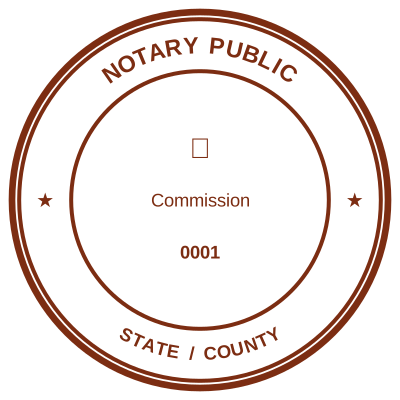


Open the stamp maker and start from any of these
A notary stamp is one of the few stamps whose contents are prescribed rather than chosen. Most business stamps carry whatever the business decides looks right. A notarial mark carries what the commissioning authority says it carries, and a document can be rejected for a missing line. That makes the wording the whole job, and the design the easy part.
This page covers what goes on the mark, how a stamp differs from a notary seal embosser, and how to lay one out.
What a notary stamp carries
The exact list is set by the jurisdiction that issued the commission, so check yours before ordering anything. Across most of them, the mark carries some combination of:
- The notary's name, exactly as it appears on the commission, not a shortened version.
- The words Notary Public, or the local equivalent.
- The jurisdiction: the state, province, county or country the commission is held in.
- The commission or licence number.
- The commission expiry date, on the mark or written beside it.
- In some places, a seal device or coat of arms.
The two that catch people out are the name and the expiry. The name has to match the commission character for character, including a middle initial if the commission carries one. The expiry either has to be on the stamp, which means reordering a physical die every renewal, or handwritten beside it, which means remembering to. A digital mark solves that particular problem, because the date is a field you edit rather than rubber you replace.
Stamp, seal or embosser
Three words that get used for the same object and should not be.
A notary stamp is an inked impression: rubber or digital, ink on the page, legible on a photocopy and on a scan.
A notary seal embosser presses the paper between two dies and leaves a raised, colourless impression. It is tamper-evident in a way ink is not, because you cannot photocopy a raised surface. It is also invisible on a scan, which is why many jurisdictions that require an embosser also require an inked stamp alongside it, or allow the embossed area to be inked over.
A common seal is a different thing again, a company instrument rather than a notarial one. We separate the two properly in stamp vs seal.
If your work is delivered as PDFs, the embosser is the part that does not survive the pipeline. An inked mark scans; a raised one does not.
Shape and size
Round and rectangular are both standard, and which is expected depends entirely on the jurisdiction. Some prescribe one. Some prescribe a maximum size and leave the rest open.
A round notarial mark is conventionally 38mm to 42mm across, which is enough for a ring of text around the edge and two or three lines in the middle. A rectangular one is usually around 55mm by 20mm, laid out as three or four stacked lines, which is easier to read and easier to fit into the margin of a crowded page.
If yours is prescribed, follow it. If it is not, the rectangle is the more practical shape for a stamp that has to sit beside a signature block without covering anything, and the round mark is the more conventional one for a formal instrument. Both are in the maker: round stamp and rectangle stamp.
Making one
- Open the stamp maker and pick a notarial template, or start from a blank round or rectangular shape.
- Replace the name line with the name exactly as commissioned.
- Set the jurisdiction line and the commission number.
- Add the expiry as a date line if your jurisdiction wants it on the mark. It stays editable, so a renewal is an edit rather than a reorder.
- Set the ink colour. Black and dark blue are the usual choices for notarial work; check whether yours specifies one.
- Preview at actual size before downloading. A commission number that is unreadable at 38mm is a commission number that will be questioned.
- Download the PNG with a real alpha channel for documents, or the SVG if a physical stamp maker is cutting a die from it.
Templates set up for this work:
Read more: Is a company seal still required?
Related professional marks
The same layout problem shows up across the professions that sign off documents in their own name.
- A commissioner for oaths stamp mark, which in many jurisdictions is a lower tier of the same function.
- An advocate stamp, which carries a roll number rather than a commission number.
- A chartered accountant seal, carrying a membership number.
- A professional engineer seal, which in most jurisdictions carries a licence number and a state.
- A justice of the peace stamp.
All of them share the same failure: the number is the part that matters and the part most likely to be set too small.
This is a design tool rather than a source of notarial guidance. What a notarial mark must carry is set by the authority that issued the commission and it differs sharply between jurisdictions, so your own commissioning paperwork is the answer and this page is not. Producing a mark for a commission you do not hold is forgery, and the terms of use prohibit it.
Common questions
Can a notary use a digital stamp?
Whether an electronic notarial act is permitted, and in what form, is set by the commissioning jurisdiction, and the rules differ sharply between them. Many now permit some form of electronic or remote online notarisation with specific requirements about the mark and the certificate attached to it. Check your own commission's rules before relying on a digital mark for a notarial act. What is uncontroversial is using a digital version for the office paperwork around the act.
Does the commission expiry have to be on the stamp?
In some jurisdictions yes, in others it can be written beside the impression. If yours requires it on the mark and you use a rubber stamp, you are reordering the die each renewal cycle.
What size should a notary stamp be?
Where a maximum is prescribed, that governs. Otherwise, 38mm to 42mm for a round mark and roughly 55mm by 20mm for a rectangular one are the conventional sizes, chosen so the mark reads clearly without swallowing the page.
What ink colour do notaries use?
Black and dark blue are the usual choices, on the basis that both photocopy cleanly. Some jurisdictions specify. Purple and green are best avoided on anything that may be scanned in greyscale.
Can I make a notary stamp online?
Yes, the layout part. Open the notary stamp maker, set your own commission details and download it. What no tool can do is tell you what your jurisdiction requires on the mark, so read the commission paperwork first and design to it.
Read next: the types of stamp an office needs, and is a company seal still required.
Every kind of stamp and seal
- Rubber stamps
- Rubber stamp maker
- Self-inking stamps
- Office stamps
- Official stamps
- Company seals
- Corporate stamps and seals
- Company chops
- Seals for civil servants
- Justice and court stamps
- Legal and advocate stamps
- Certified true copy stamps
- Medical stamps
- Pharmacy stamps
- Veterinary stamps
- Engineer and architect seals
- Land surveyor seals
- Bank stamps
- School and principal stamps
- Teacher and marking stamps
- University and college seals
- Library stamps
- Inspection stamps
- Courier and logistics stamps
- Construction and site stamps
- Real estate stamps
- Hotel and restaurant stamps
- Church and charity seals
- Tender and bid stamps
- HR and payroll stamps
- Received and paid stamps
- Confidential and draft stamps
- Signature stamps
- Date stamps
- Custom band stamps
- Numbering stamps
- Address stamps
- Monogram stamps
- Wedding stamps
- Gift and craft stamps
- Art and logo stamps
- Wax and foil seals
- Stamp or seal, by profession