What is a self inking stamp, and how does one work
5 September 2026 · Estamplab
Make your stamp free · Browse 225 templates
A self inking stamp is a hand stamp that carries its own ink pad inside the body. The rubber die sits upside down against the pad while the stamp is at rest, and pressing it flips the die over, prints the impression, and flips it back onto the pad ready for the next one.
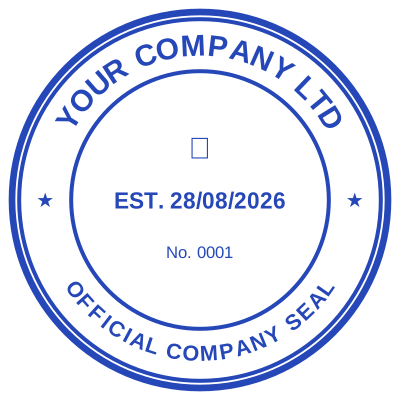

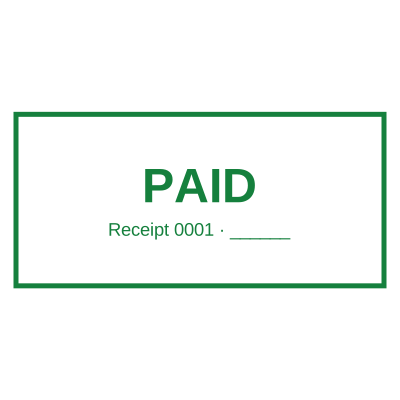

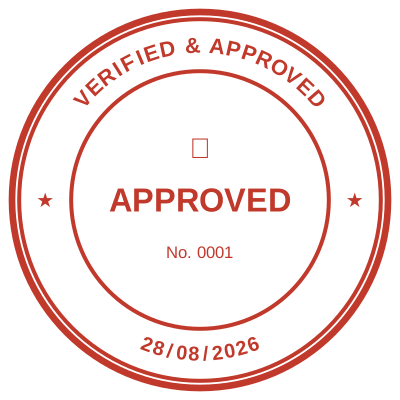

Open the stamp maker and start from any of these
That is the whole invention. Everything else about it follows from that one hinge.
The parts, and what each one is for
Open a self-inking stamp and there are four things in it.
- The die. A moulded rubber or photopolymer plate carrying your wording in mirror image, raised where the ink goes. It is cut once, from the artwork supplied, which is the single most important fact about the object: changing a line means a new die.
- The pad. A felt or foam block soaked in ink, sitting in a tray at the top of the housing. On most models it lifts out and can be re-inked from a bottle or swapped for a fresh one.
- The mechanism. A spring and a pair of guide slots that rotate the die 180 degrees as the body is pressed down. This is what separates a self-inking stamp from a plain rubber stamp, where you ink from a separate pad by hand.
- The housing. Usually ABS plastic, with a window on the front that holds a printed label telling you what the stamp says, because you cannot read the die.
How it differs from the other two mechanisms
There are three ways to get ink onto rubber, and the words for them get used loosely.
A traditional rubber stamp is a die on a wooden or plastic handle. You press it onto a separate stamp pad, then onto the paper. Cheapest, most control over ink colour, slowest, and the pad is a separate thing to lose.
A self inking stamp is the one described above. It is the office default because it is quick, it needs no second object on the desk, and the pad is replaceable. Expect somewhere in the region of several thousand impressions before it wants re-inking, and a re-ink is a two minute job.
A pre-inked stamp has no pad at all. The ink lives inside the die itself, in a porous material that weeps it through the raised areas under pressure. The impression is noticeably sharper and more even, it lasts far longer between refills, and it costs more. For a logo or fine detail it is the better object. For a PAID stamp, nobody will ever notice.
There is a longer comparison of the middle two in self inking stamps against pre-inked ones.
Is a self ink stamp the same thing?
Yes. Self ink stamp, self-inking stamp and self inking stamp are the same object with three spellings, and no stamp shop will be confused by any of them.
A self inking seal usually means the same mechanism in a round layout, the kind a company presses on a letterhead. A seal proper, meaning the device that presses a raised impression into the paper without ink, is a different object entirely: that is an embosser, it has no pad, and it leaves a mark you read by tilting the page towards the light.
What a dated one adds, and what it costs you
A self-inking date stamp puts three rubber bands inside the die: day, month and year. You turn them with a fingertip or a small wheel on the side.
They are the reason dated stamps exist and they are also the weak point of the whole design. Somebody has to turn them, every working morning, and the morning nobody does is the morning a hundred documents get stamped with yesterday. On a RECEIVED stamp that is not cosmetic. The stamp exists to record when something arrived, and a wrong date is a record that says the wrong thing, confidently, in ink.
What actually fails, in the order it usually happens
- The pad dries at one end. The impression comes out solid on the left and ghosted on the right. This is the commonest complaint and it is a re-ink, not a fault.
- Somebody re-inks it with the wrong ink. A dye ink in a pad designed for pigment, or vice versa, and everything the stamp touches afterwards smudges. Match the ink to the pad, or replace the pad.
- The die picks up paper fibre. Letters with closed loops fill in first, so an 8 starts printing as a blob. A wipe with a damp cloth fixes it early and nothing fixes it late.
- The wording goes out of date. A moved office, a new phone number, a changed registration, a director who left. Nothing is wrong with the stamp at all, and it still has to be replaced.
That last one is the expensive failure, and it is the one nobody budgets for. The block is bought once and re-bought every time a detail changes.
What size is a self inking stamp
Sizes are set by the housing you order, not by you, so pick the wording to fit the body rather than the other way round.
As a rough guide, a round company seal is commonly 38mm to 42mm across, and a rectangular details or address stamp is often around 58mm by 22mm. The real constraint is not the outside measurement, it is the text: below roughly 6pt at true size a pressed impression stops being reliably readable, so every line you add makes the others smaller. Design at the size it will be used at, never zoomed in.
When a self inking stamp is still the right answer
When the paper is in front of you and there is a queue behind it.
A front desk logging deliveries, a clinic reception, a records office, a passport counter, a delivery book signed at a door: a block is faster than any file, needs no device, and works when the power is out. Nothing on this site is an argument against owning one for that job, and if that is your job, buy one.
When it is the wrong answer
When the document is a file and stays a file.
An invoice that arrives as a PDF and goes back as a PDF does not need a rubber stamp. Marking it with one means printing the document so you can press the block on it, then scanning it back in, which produces a worse copy of a document you already had, and the scan is what the other side files.
For that case the same wording works better as a digital stamp: it is placed on the file directly, the date can fill itself in at the moment it is used, and a serial number can step on with each download, which no cut die can do. There is a part by part version of this on the self inking stamp alternative page, and the broader case on the alternative to a rubber stamp.
Plenty of offices need both. The thing worth stopping is the middle case, where paper is being created purely so a stamp can be pressed on it.
Frequently asked questions
How does a self inking stamp work?
The die is mounted on a frame that rotates as you press. At rest the die faces upwards against an ink pad in the top of the housing. Pressing the body down rotates the die 180 degrees so it faces the paper, presses the impression, and the spring returns it to the pad on the way back up. It re-inks itself on every stroke, which is the whole point of the name.
How many impressions before it needs re-inking?
Several thousand is the usual figure quoted for a self-inking pad, against a considerably higher number for a pre-inked stamp, where the ink reservoir is the die itself. Both vary with the size of the die, how much of it is solid, and how hard the person pressing it leans. Treat any single number you are quoted as an order of magnitude rather than a promise.
Can I change the wording on a self inking stamp?
Not on the die. It is moulded once from the artwork, so a change of wording is a new die and, on most models, a new stamp. Some housings take a replacement die plate, which is cheaper than a whole stamp if your supplier offers it. If the wording is going to change, that is the strongest argument for keeping the mark as a file, where editing it costs nothing.
Is a self inking stamp the same as a pre-inked stamp?
No. Self-inking has a separate pad the die flips onto. Pre-inked has no pad: the ink is held inside the die. Pre-inked gives a sharper impression and lasts longer between refills, self-inking is cheaper and easier to re-ink or change colour on.
Can I get the same stamp as a file?
Yes, and it is free to design and preview. Build the same wording and layout in the editor, set it to the size of your existing impression so the two match on paper, and download it as a transparent PNG for documents or an SVG for print. If you later want the physical block as well, the SVG is the format a stamp shop asks you to supply.
:::cta
Every kind of stamp and seal
- Notary stamps and seals
- Rubber stamps
- Rubber stamp maker
- Office stamps
- Official stamps
- Company seals
- Corporate stamps and seals
- Company chops
- Seals for civil servants
- Justice and court stamps
- Legal and advocate stamps
- Certified true copy stamps
- Medical stamps
- Pharmacy stamps
- Veterinary stamps
- Engineer and architect seals
- Land surveyor seals
- Bank stamps
- School and principal stamps
- Teacher and marking stamps
- University and college seals
- Library stamps
- Inspection stamps
- Courier and logistics stamps
- Construction and site stamps
- Real estate stamps
- Hotel and restaurant stamps
- Church and charity seals
- Tender and bid stamps
- HR and payroll stamps
- Received and paid stamps
- Confidential and draft stamps
- Signature stamps
- Date stamps
- Custom band stamps
- Numbering stamps
- Address stamps
- Monogram stamps
- Wedding stamps
- Gift and craft stamps
- Art and logo stamps
- Wax and foil seals
- Stamp or seal, by profession