Blog › Company stamps and seals
Office stamps: the four an office actually presses
3 September 2026 · Estamplab
Make your stamp free · Browse 225 templates

Open the stamp maker and start from any of these
Walk up to any office stamp drawer and you will find eight of them, three of which are dry, two of which have the old address on them, and one that nobody can identify. The set that gets used is smaller than the set that gets bought, and it is almost always the same four marks.
Open the stamp maker and start from any of these
The four an office presses
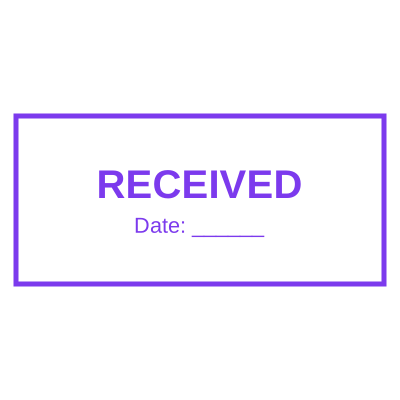
The received stamp. A box with the company name, the word RECEIVED and a date. It goes on everything that arrives: post, invoices, delivery notes, applications. It is the most used stamp in any office and the one people forget to order, because it does not feel important until somebody asks when a document turned up. Ours fills the date in itself, which is the whole received stamp maker argument.
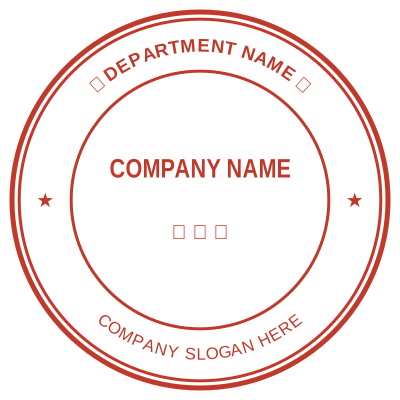
The company identity mark. The registered name, the registration number and the town. It goes on quotes, letters, invoices and anything leaving the building on paper. This is the company stamp, and it is the only one on this list that says who you are rather than what happened.
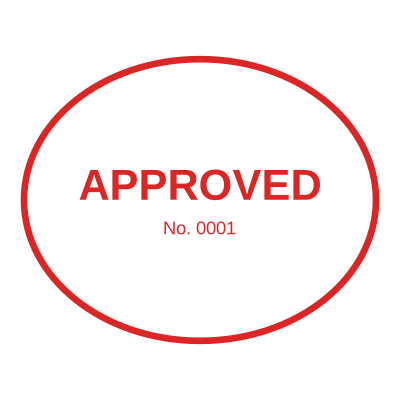
The approval mark. APPROVED, CHECKED or AUTHORISED, with a line for initials and a date. It is what turns a document from a draft somebody produced into a document somebody stands behind. See the approved stamp and the checked stamp.
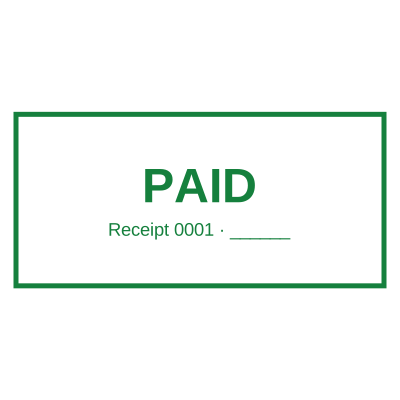
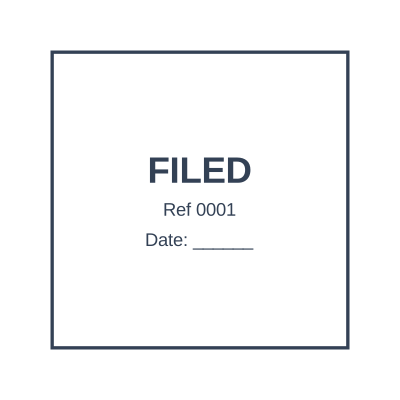
The paid or filed mark. PAID with a date for accounts, FILED for records. Both exist to stop the same document being worked twice, which is the single most common piece of duplicated office work. There is a paid stamp for the first and a plain box for the second.
Everything else in that drawer is a specialisation of one of these four.
What actually goes on an office stamp
Keep it to what will still be true in two years.
- The registered name, spelled as registered. Not the trading shorthand.
- The registration number, if the mark is going on anything commercial.
- The town or the branch, if you have more than one.
- A date, when the mark is a record rather than an identity.
- A line for initials, when somebody has to be answerable for the mark.
Leave off the phone number, the email address and the website. Those change, and a stamp with a dead phone number on it is worse than a stamp without one. Leave off the tagline entirely: an office stamp is a record, not an advertisement.
Rectangle or round
A rectangle reads faster, holds four straight lines, and is what an office wants for a received or approval mark. A circle reads as identity, which is why the company mark is round almost everywhere in the world. The full argument is in stamp shapes and sizes, and the shapes themselves are on the rectangle stamp and round seal pages.
Size: about 56mm across for a round identity mark, and roughly 56 by 22mm for a rectangle. That is a real rubber stamp size and it is what our files are tagged at, so a download lands correctly in Word rather than four times too wide.
The office stamp problem nobody plans for
The stamps live in one drawer, in one building, and half the office is not in that building. A document that needs the received mark on a Tuesday afternoon waits until somebody who can reach the drawer is back at their desk.
That is the actual reason offices go digital with the mark rather than any argument about ink. A digital stamp for documents is a file: it sits in the shared drive, three people can use it in the same minute, and nothing runs dry. When the address changes you edit the mark instead of reordering four of them.
Read more: What actually goes wrong with a physical stamp
Making the set
- Open the stamp maker and start from a template close to the mark you want. The business templates hold the received, approved and paid layouts, and the company templates hold the identity marks.
- Replace the placeholder wording. Keep the registration number large enough to read at actual size.
- Set the ink colour. Blue for identity, red for status marks like PAID and VOID.
- Add the date on anything that is a record. It fills itself in and stays editable in the Word download.
- Download the transparent PNG for pasting into documents, or put the stamp straight onto a PDF.
What an office stamp does not do
It does not prove who applied it. Anybody holding the stamp, or holding the file, can press it. That is true of the rubber article as well, and it is why the mark sits beside a signature rather than in place of one on anything that matters.
For the full range, including the marks specific to a trade rather than to an office, see every stamp and seal we make.
Every kind of stamp and seal
- Notary stamps and seals
- Rubber stamps
- Rubber stamp maker
- Self-inking stamps
- Official stamps
- Company seals
- Corporate stamps and seals
- Company chops
- Seals for civil servants
- Justice and court stamps
- Legal and advocate stamps
- Certified true copy stamps
- Medical stamps
- Pharmacy stamps
- Veterinary stamps
- Engineer and architect seals
- Land surveyor seals
- Bank stamps
- School and principal stamps
- Teacher and marking stamps
- University and college seals
- Library stamps
- Inspection stamps
- Courier and logistics stamps
- Construction and site stamps
- Real estate stamps
- Hotel and restaurant stamps
- Church and charity seals
- Tender and bid stamps
- HR and payroll stamps
- Received and paid stamps
- Confidential and draft stamps
- Signature stamps
- Date stamps
- Custom band stamps
- Numbering stamps
- Address stamps
- Monogram stamps
- Wedding stamps
- Gift and craft stamps
- Art and logo stamps
- Wax and foil seals
- Stamp or seal, by profession