Blog › Notary and legal stamps
Official stamps: what the word actually means
3 September 2026 · Estamplab
Make your stamp free · Browse 225 templates

Open the stamp maker and start from any of these
"We need an official stamp on this." It is one of the most common requests in office life and one of the least specific, because the word official is doing five different jobs at once. Sorting out which one you have been asked for is most of the work.

Open the stamp maker and start from any of these
The five things people mean
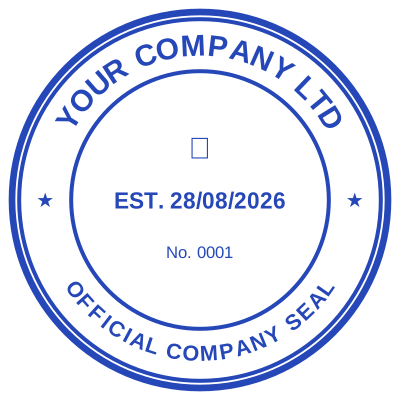
1. An identity mark from an organisation. Ninety per cent of requests. Somebody wants to see that the document came from your company rather than from a person with a laptop. What they want is the company stamp or company seal, and you can make that yourself today.
2. A mark from a public body. A ministry, a registry, a council, a court office. That seal belongs to the office and is applied by the office. You cannot make one, and you should not want to: the whole value of it is that only they have it. What you can make is your own organisation's mark for the covering letter. See the notes on the government seal page.
3. An attestation or certification mark. CERTIFIED TRUE COPY, ATTESTED, WITNESSED. These certify an act rather than an identity, and the person who applies one is saying something about the document that they can be held to. Which people may certify what is a matter of local law. The certified true copy stamp and attestation stamp carry the wording.
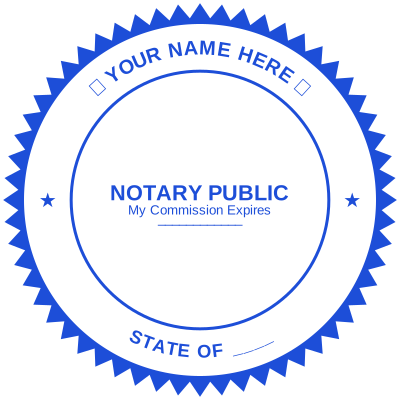
4. A notarial seal. A notary's mark, applied by a commissioned notary. It is not a stamp somebody buys because it looks official, and in most jurisdictions the notary's commission specifies the layout. The notary stamp and seal guide covers this properly.
5. Stamp duty. In India, Malaysia, Singapore and a few other markets, "official stamp" can mean the revenue payment on an instrument, which has nothing to do with a rubber stamp at all. That is covered on the e-stamping and stamp duty page, and confusing the two is the most expensive mistake on this list.
How to tell which one you have been asked for
Ask what happens to the document next.
If it goes to a customer, a supplier or a bank as proof of who issued it, they want your organisation's identity mark. If it goes to a court, a registry or an embassy, read the receiving body's own instructions, because they will name the mark they require and often specify its wording. If somebody says "get it stamped", ask by whom.
What goes on an organisation's official mark
- The registered name, exactly as registered.
- The registration number, which is the part that makes the mark checkable.
- The jurisdiction, town or branch.
- Sometimes the year of incorporation on the lower ring.
That is the whole list. An official-looking mark with a decorative crest and no registration number is less useful than a plain circle with the number on it, because the number is what somebody can verify and the crest is what anybody can draw.
The word official on the stamp itself
Marks reading OFFICIAL, OFFICIAL USE ONLY or FOR OFFICIAL USE ONLY are routing instructions inside an organisation rather than claims of authority. They mean this copy is the internal one. The for official use only stamp is the one to use for that, and it is a genuinely useful mark on internal paperwork.
Read more: How to read a mark somebody has sent you
The honest limits
Estamplab is a design tool. What follows describes common commercial practice rather than giving legal advice, and practice changes.
A stamp is a mark on a document. It does not confer authority that the person applying it does not already have, it does not make a document binding, and applying a public body's seal to a document you are not entitled to use is forgery rather than a design decision. Only produce a mark your own organisation or your own credentials entitle you to use.
Which mark a document actually needs is set by the authority receiving it, so check the requirement with them rather than with a page like this one.
What a stamp does well is answer the everyday question of which organisation issued a piece of paper, quickly and legibly, and that is what almost everybody asking for an official stamp actually needs. Start from the full list of stamp and seal types, or open a company template and put your own name on it.
Every kind of stamp and seal
- Notary stamps and seals
- Rubber stamps
- Rubber stamp maker
- Self-inking stamps
- Office stamps
- Company seals
- Corporate stamps and seals
- Company chops
- Seals for civil servants
- Justice and court stamps
- Legal and advocate stamps
- Certified true copy stamps
- Medical stamps
- Pharmacy stamps
- Veterinary stamps
- Engineer and architect seals
- Land surveyor seals
- Bank stamps
- School and principal stamps
- Teacher and marking stamps
- University and college seals
- Library stamps
- Inspection stamps
- Courier and logistics stamps
- Construction and site stamps
- Real estate stamps
- Hotel and restaurant stamps
- Church and charity seals
- Tender and bid stamps
- HR and payroll stamps
- Received and paid stamps
- Confidential and draft stamps
- Signature stamps
- Date stamps
- Custom band stamps
- Numbering stamps
- Address stamps
- Monogram stamps
- Wedding stamps
- Gift and craft stamps
- Art and logo stamps
- Wax and foil seals
- Stamp or seal, by profession