Blog › Stamps around the world
Company stamps by country
14 August 2026 · Estamplab
Make your stamp free · Browse 225 templates
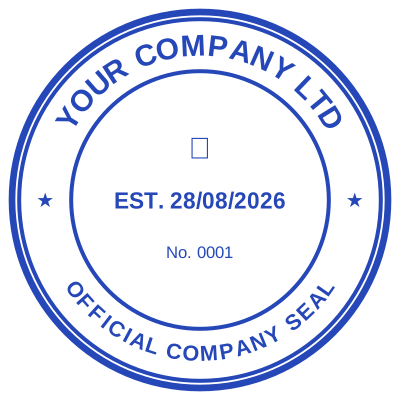

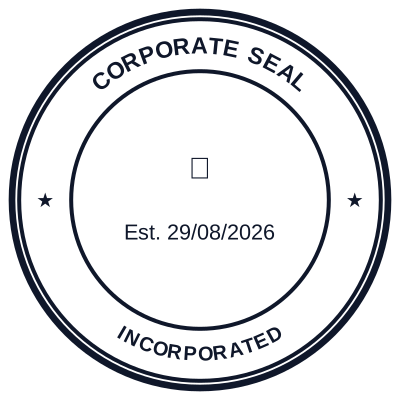
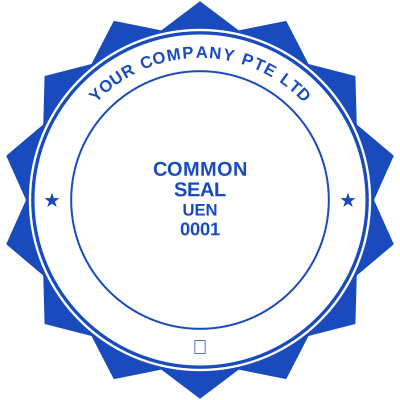


Open the stamp maker and start from any of these
A company stamp is one object with about six different jobs, and which job it has depends entirely on where the company was registered. The same red circle that is merely decorative in New York can commit a company to a contract in Shanghai. That is not a detail. It decides who is allowed to hold the stamp, what has to be printed on it, and whether losing it is an inconvenience or an emergency.
This is the map, grouped by how the law actually treats the mark rather than by continent.
Where the seal binds the company
Across much of East and Southeast Asia the chop is the company. A contract bearing the chop can bind the company even without a signature, which makes custody a governance question rather than a stationery one.
In mainland China, a company typically holds several chops with different powers: the company chop, the legal representative chop, the finance chop, the contract chop and the invoice chop. Losing control of the company chop is the corporate equivalent of losing control of the bank account, and disputes over who physically holds it have shut real businesses down. Companies registered in Beijing, Shanghai, Shenzhen and Guangzhou all follow the same practice.
Hong Kong keeps the common seal from English law alongside the chop, and many companies maintain both: the seal for deeds and share certificates, a rubber chop for everyday paperwork.
Japan uses the hanko or inkan, and the registered jitsuin is filed with the local legal affairs bureau. South Korea uses the dojang the same way. In both, a registered seal certificate is what a counterparty asks for when the stamp matters.
Taiwan, Singapore, Malaysia, Indonesia, Vietnam and Thailand all sit somewhere on this spectrum. In Vietnam the seal was until recently registered with the police, and the mark still carries considerable weight in practice even after the rules loosened.
What to put on it: the registered company name in the local script, the registration or business number, and for the Chinese chop the star at the centre that convention expects. Red, always. A blue chop reads as wrong before anybody has finished looking at it.
Where the seal is optional and mostly historical
The English common law tradition invented the common seal and has spent forty years making it unnecessary.
In the United Kingdom, the Companies Act 2006 removed the requirement. A document can be executed by two directors, by a director and the company secretary, or by a director whose signature is witnessed. Companies registered in London, Manchester, Birmingham or Edinburgh are under the same rule. Plenty keep a stamp anyway, for letterheads, share certificates and for overseas counterparties who expect to see one.
Ireland is similar but not identical: the common seal survives in the Companies Act 2014 and is still used for deeds, so an Irish company is more likely to genuinely need one than a British company.
Australia, New Zealand, Canada and South Africa all made the seal optional. In Canada the corporate seal still turns up in minute books and on share certificates out of habit, and a company in Toronto or Vancouver will usually have one in a drawer without ever needing it.
India is the interesting case in this group. The Companies Act 2013 made the common seal optional in 2015, and yet the rubber stamp is close to universal in Indian business practice. Banks, registrars and counterparties in Mumbai, Delhi, Bengaluru and Chennai ask for it as a matter of course. The law says you do not need it; the person in front of you says otherwise, and they are the one holding up your paperwork.
What to put on it: the registered name exactly as it appears at the registry, the company number (a UK CRN, an Indian CIN, an Australian ACN), and often the year of incorporation on a traditional seal.
Where the stamp is administrative rather than legal
Across much of the Middle East, Africa and Latin America the company stamp is not usually what makes a document valid, but almost nothing moves without it.
In the UAE, including Dubai and Abu Dhabi, the company stamp accompanies an authorised signature on invoices, contracts, government submissions and bank instructions. Free zone and mainland companies both use one. Saudi Arabia, Qatar, Kuwait, Oman and Bahrain follow closely comparable practice.
In Nigeria, Kenya, Ghana, Tanzania and Uganda, the company seal is a fixture. Kenyan companies are asked for the stamp on everything from tender submissions to bank mandates, and a document arriving in Nairobi, Lagos or Accra without one gets sent back long before anybody reads it. The registration number matters here more than anywhere: it is what a counterparty checks you against.
Egypt, Morocco and Tunisia use the stamp similarly, usually bilingually.
Across Latin America, Brazil, Mexico, Chile, Colombia and Argentina use company stamps administratively, often alongside a registered tax number that is the real identifier: a CNPJ in Brazil, an RFC in Mexico, a RUT in Chile. In Sao Paulo, Mexico City and Santiago the number on the stamp is what gets typed into somebody's system.
What to put on it: the trading name, the registration number, and the tax identifier your customers need in order to pay you. That last one is the single most useful thing on the stamp and the one most often left off.
Where it is ceremonial
In the United States, the corporate seal is driven by institutions rather than by statute. It is asked for on stock certificates, on board and member resolutions, by banks opening accounts, by title companies at closing and by lenders before they release funds, which is why the corporate kits sold to new companies in New York, Los Angeles, Chicago and Austin all still contain one. No state requires it to form the company, so the moment it is needed is usually a moment of short notice, and having the file already made is the whole advantage.
Where an American stamp does real work it is usually a professional seal rather than a corporate one: a notary seal, an engineer's or architect's seal, each with wording prescribed by the state board that issued the licence.
Much of Western Europe sits here too. Germany, France, the Netherlands, Spain, Italy, Sweden, Switzerland, Poland, Portugal and Finland rely on registered signatures and commercial register extracts rather than seals. A German Firmenstempel is common on invoices and correspondence and carries no legal force of its own. A company in Berlin, Paris, Amsterdam or Madrid uses one because it looks established, which is a real reason but not a legal one.
What does not change
Four things are true everywhere, and they are the things worth getting right.
The identifying number matters more than the design. Whatever the jurisdiction, somebody downstream is checking your company against a register. The number is how they do it. A beautiful seal without it is a decoration.
The name has to match the register exactly. Trading names, abbreviations and the version on your website all cause the same problem: the document gets queried by someone who cannot match it to the entity.
Custody is a policy, not a drawer. In chop jurisdictions this is obvious. Everywhere else it is still true, because a stamp anybody can apply is a stamp that proves nothing about who applied it.
The document decides, not the country. Everything above is the general shape. A specific registry, bank or counterparty can require something different, and they are the ones who will hold up your paperwork. Ask them.
Making one
Whichever convention you are working to, the shape is the same job: a name curved around a ring and a number in the middle. Start from the company seal maker for the western round seal, or the company chop maker if you need the red Asian chop, and change the wording.
Estamplab has a page for each of these jurisdictions, covering what convention expects and what to put on the mark. Start with your own and the wording is mostly decided for you.
Estamplab is a design tool. The above describes common commercial practice, not legal advice, and practice changes. Where a specific document matters, check the requirement with the body receiving it.
Every kind of stamp and seal
- Notary stamps and seals
- Rubber stamps
- Rubber stamp maker
- Self-inking stamps
- Office stamps
- Official stamps
- Company seals
- Corporate stamps and seals
- Company chops
- Seals for civil servants
- Justice and court stamps
- Legal and advocate stamps
- Certified true copy stamps
- Medical stamps
- Pharmacy stamps
- Veterinary stamps
- Engineer and architect seals
- Land surveyor seals
- Bank stamps
- School and principal stamps
- Teacher and marking stamps
- University and college seals
- Library stamps
- Inspection stamps
- Courier and logistics stamps
- Construction and site stamps
- Real estate stamps
- Hotel and restaurant stamps
- Church and charity seals
- Tender and bid stamps
- HR and payroll stamps
- Received and paid stamps
- Confidential and draft stamps
- Signature stamps
- Date stamps
- Custom band stamps
- Numbering stamps
- Address stamps
- Monogram stamps
- Wedding stamps
- Gift and craft stamps
- Art and logo stamps
- Wax and foil seals
- Stamp or seal, by profession