Blog › Stamps around the world
Do I need a company seal in the UK?
1 September 2026 · Estamplab
Make your stamp free · Browse 225 templates

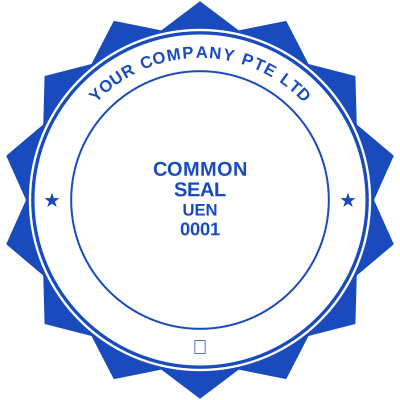
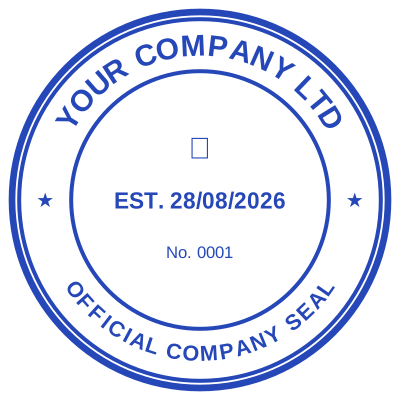
Open the stamp maker and start from any of these
A customer in Dubai, Lagos or Singapore has sent your contract back because it has no company stamp on it. That is what usually brings a UK company here, and the answer is in two parts.
Your own law does not require a seal: the Companies Act 2006 made the common seal optional, and two director signatures execute the document perfectly well. Your customer does not care, and their document will keep coming back until it carries a mark. You can make one that satisfies them in about two minutes.
Then why does everybody keep asking for one?
Three reasons, and only one of them is British.
Your articles of association. If the articles provide that a seal shall be used for a particular instrument, that binds the company even though the general law would not. This is the one to actually check, and it takes two minutes.
Share certificates and formal instruments. Tradition rather than requirement, but registrars, transfer agents and company secretarial firms often still expect a sealed certificate, and it is easier to produce one than to argue.
Everybody outside the UK. In much of Africa, the Gulf, South and East Asia, a company mark is how a company signs. A UK contract arriving with two signatures and no stamp does not look executed to a counterparty in Lagos, Dubai or Jakarta, and it comes back. That is the reason most UK exporters end up with a stamp: not because Companies House wants one, but because their customers do.
Common seal, company seal, company stamp
The words get used interchangeably and they mean three different things.
The common seal is the formal instrument. Historically embossed into the paper to execute a deed, its use minuted, its custody controlled.
A company seal in ordinary speech is the round inked mark carrying the company name and number. Evidence of who issued the document, not a formality of execution.
A company stamp is everything else: the address block, the received stamp with the date, PAID, the authorised signatory line. No legal weight and a great deal of daily use.
What goes on a UK company stamp
- The registered company name exactly as it appears at Companies House.
- The company registration number, the eight character CRN.
- Often the registered office town, or the year of incorporation on a traditional seal.
- Sometimes the words "Common Seal" where the mark is standing in for one.
Exactly as registered matters more than it sounds. If Companies House holds "Smith and Sons (Trading) Limited", a seal that says "Smith & Sons Ltd" is the one that gets a query from the counterparty who checked the register.
What about deeds?
A deed still has to be executed as a deed, which means the right signatures, the right attestation, and delivery. A seal is not what makes it one, and applying a seal to a document does not turn it into a deed. Where a specific instrument, a land transaction or a filing has its own execution requirements, those come from the law governing it, so take that from your solicitor rather than from a stamp maker.
Making one
A stamp is a file. Design it, download it, and it goes onto a PDF contract, a Word invoice or a share certificate in a minute, from a laptop or a phone. When the registered office moves you edit it rather than reordering a die and waiting a week for the post.
Two things worth getting right: keep it around 40mm across so the ring text survives being printed and scanned, and use one solid ink, blue or black, because a pale multi colour mark disappears in a scan and is what makes a stamped document look like a graphic.
This describes common commercial practice, not legal advice. Check your articles, and check any specific requirement with your solicitor or the body asking. Only produce a mark your own company is entitled to use: making one for a company you do not act for is forgery.
Every kind of stamp and seal
- Notary stamps and seals
- Rubber stamps
- Rubber stamp maker
- Self-inking stamps
- Office stamps
- Official stamps
- Company seals
- Corporate stamps and seals
- Company chops
- Seals for civil servants
- Justice and court stamps
- Legal and advocate stamps
- Certified true copy stamps
- Medical stamps
- Pharmacy stamps
- Veterinary stamps
- Engineer and architect seals
- Land surveyor seals
- Bank stamps
- School and principal stamps
- Teacher and marking stamps
- University and college seals
- Library stamps
- Inspection stamps
- Courier and logistics stamps
- Construction and site stamps
- Real estate stamps
- Hotel and restaurant stamps
- Church and charity seals
- Tender and bid stamps
- HR and payroll stamps
- Received and paid stamps
- Confidential and draft stamps
- Signature stamps
- Date stamps
- Custom band stamps
- Numbering stamps
- Address stamps
- Monogram stamps
- Wedding stamps
- Gift and craft stamps
- Art and logo stamps
- Wax and foil seals
- Stamp or seal, by profession