Blog › Stamps around the world
Does an LLC need a seal?
1 September 2026 · Estamplab
Make your stamp free · Browse 225 templates
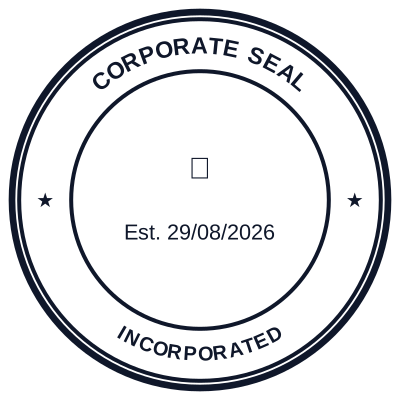


Open the stamp maker and start from any of these
Your bank has asked for a corporate seal on a resolution, and your LLC has never had one. That is the usual reason this page gets opened, so the answer comes first: no state requires one, and you can have a proper seal on the document in about two minutes.
Almost every page ranking for this question sells you an embosser before it tells you that. Here is the useful version.
Who actually asks for a corporate seal
- Banks, when opening a business account or accepting a corporate resolution. This is the most common one by a distance.
- Title companies and closing agents, on documents at a real estate closing.
- Transfer agents, on stock certificates, where the seal is traditional.
- Foreign counterparties, especially in Asia, the Gulf and much of Africa, where a company mark is how a company signs and an unsealed contract reads as unsigned.
- Your own operating agreement or bylaws, which sometimes provide for a seal on particular instruments. That provision binds the company even though state law does not, so it is worth reading before you decide you do not need one.
What goes on it
A US corporate or LLC seal is conventionally round, with:
- The full registered entity name, including the Inc, Corp or LLC suffix, exactly as filed.
- The state of formation.
- The year of formation.
- Often the words "Corporate Seal", or for an LLC sometimes a Member or Manager line.
Copy the certificate of formation or the articles of organization exactly. A seal that disagrees with what is on file with the Secretary of State is the one that gets questioned, and it is a five second mistake to make and a slow one to discover.
LLC seal or corporate seal
The wording differs, the standing does not. A corporation seal carries the corporate name and usually the word Corporate; an LLC seal carries the LLC name and often identifies a Member or Manager. Neither one makes a document binding on its own. Both are evidence of which entity issued the document, which is exactly what the bank or the title company is looking for.
Embosser or ink
The traditional article is a handheld embosser that presses the mark into the paper. It is satisfying and it is nearly invisible on a photocopy, which matters because almost nothing stays on paper now. An embossed seal on a page that gets scanned and emailed arrives as a faint smudge or as nothing at all.
An inked or digital seal survives the trip. If a specific institution wants a raised impression on an original, buy an embosser for that. For everything that moves as a PDF, the digital mark is the one that is still legible at the other end.
Making one that gets accepted
Three things decide whether a seal passes without comment.
Get the name exactly right. Including the suffix, including punctuation, as filed.
Keep it around 1.5 to 1.75 inches. That is the size of a physical seal and the size at which ring text is still readable after a document has been printed and scanned once.
Use one solid ink. Black or dark blue. A multi-colored seal reads as a logo, and a pale one drops out of a scan entirely.
Notary seals are a different thing
A notary seal is not in this category at all. Its contents, and often its shape and minimum size, are prescribed by the commissioning state, and using one that does not meet the requirement can invalidate the notarization. If that is what you are here for, take the format from your commissioning authority rather than from any tool, including this one.
The honest summary
You do not need a seal. You will probably be asked for one, and having one ready turns a two day delay into two minutes. Estamplab is a design tool, and this describes common commercial practice rather than giving legal advice. Where a specific document, a state or an institution imposes a requirement, that requirement governs, so check the requirement with them. Only produce a seal your own entity is entitled to use: making one for an entity you do not act for is forgery.
Every kind of stamp and seal
- Notary stamps and seals
- Rubber stamps
- Rubber stamp maker
- Self-inking stamps
- Office stamps
- Official stamps
- Company seals
- Corporate stamps and seals
- Company chops
- Seals for civil servants
- Justice and court stamps
- Legal and advocate stamps
- Certified true copy stamps
- Medical stamps
- Pharmacy stamps
- Veterinary stamps
- Engineer and architect seals
- Land surveyor seals
- Bank stamps
- School and principal stamps
- Teacher and marking stamps
- University and college seals
- Library stamps
- Inspection stamps
- Courier and logistics stamps
- Construction and site stamps
- Real estate stamps
- Hotel and restaurant stamps
- Church and charity seals
- Tender and bid stamps
- HR and payroll stamps
- Received and paid stamps
- Confidential and draft stamps
- Signature stamps
- Date stamps
- Custom band stamps
- Numbering stamps
- Address stamps
- Monogram stamps
- Wedding stamps
- Gift and craft stamps
- Art and logo stamps
- Wax and foil seals
- Stamp or seal, by profession