Blog › Company stamps and seals
Embossed seals and inked stamps, and which one a document needs
2 September 2026 · Estamplab
Make your stamp free · Browse 225 templates
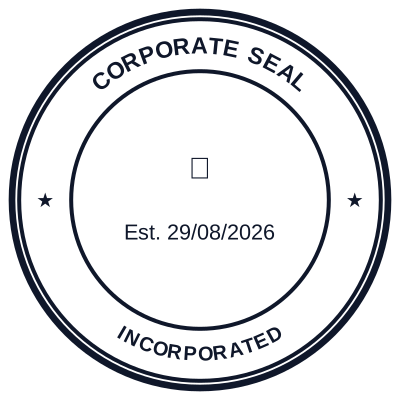

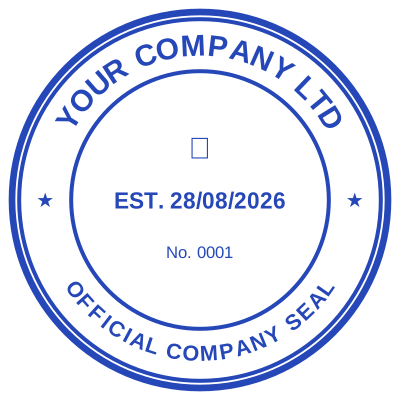



Open the stamp maker and start from any of these
An embossed seal and an inked stamp do the same job by opposite means, and the difference decides which one a document actually needs. The embosser squeezes the paper between two dies and leaves a raised shape with no ink in it. The stamp leaves ink and does not touch the surface. People treat this as a question of formality, and it is really a question of what happens to the document next.
What an embosser is good at
An embossed seal is hard to forge casually. Reproducing one needs a matching die rather than a scanner and a printer, which is why company registries, notaries and universities have kept them for the documents where a convincing copy would be a problem: share certificates, transcripts, certified copies, deeds.
It is also physically permanent in a way ink is not. It does not fade, run, smudge or lift with solvent, because there is nothing on the surface to remove. A hundred-year-old embossed certificate still reads.
What an embosser is bad at
It does not photocopy, and it does not scan. That is the whole difficulty, and it is not a small one. A crisp embossed seal on an original becomes nothing at all on the copy somebody emails, so a document that will be scanned and forwarded arrives looking unsealed. Registries that require embossing usually also require the original to be lodged, which is consistent. A client who asked for a "sealed" invoice and receives a PDF of an embossed one has been sent a blank space.
Offices that use both get around this by embossing the original and inking the copies, or by using an embosser with an ink pad attachment, which presses and marks in the same action.
What an inked stamp is good at
It survives every step of the modern document path: it photocopies, it scans, it faxes, and it shows up in a PDF. If the mark has to be visible to somebody who was not handed the paper, ink is the only one of the two that works.
It is also faster, cheaper, and easier to replace. A die that has to change because an address changed costs a fraction of a new embossing plate.
Which does your document need?
Ask who has to see the mark, and on what.
If a registry, a court or a professional body has specified an embossed or raised seal, they mean the physical instrument and no digital version substitutes for it. That requirement comes from them and it is worth confirming in writing rather than inferring from tradition.
If the mark exists so a bank, a customer or an auditor can tell the document came from you, ink is what they will actually see, and an official seal applied digitally to the file itself skips the printing entirely.
If the document is a share certificate or a deed, expect to need both: the embossed seal on the original for the register, and something legible on the copies everyone else works from.
The corporate seal in the middle of this
Most of the confusion sits on the phrase corporate seal, which describes an object in one sentence and a legal formality in the next. In most common law countries the formality has gone: the UK made the common seal optional in 1989 and confirmed it in the Companies Act 2006, and the US states removed the requirement for ordinary contracts long before. What remains is the object, used because a bank or a counterparty expects it.
So a company deciding between an embosser and a stamp today is making a practical choice rather than a legal one, unless its own articles say otherwise. Check the articles: they sometimes still say the seal shall be affixed in a particular way, and that is binding on the company even when the general law is silent.
Designing one either way
The wording is the same for both, and it is the part that gets a document rejected: the registered name exactly as filed, the registration number, and often the year of incorporation or the town. A seal reading a trading name that does not match the certificate is the objection you made the seal to avoid.
Design it here at the real size, look at it at that size rather than zoomed in, and you have a layout you can either apply to the document as a file or hand to an engraver to cut as an embossing plate. Both start from the same drawing.
Every kind of stamp and seal
- Notary stamps and seals
- Rubber stamps
- Rubber stamp maker
- Self-inking stamps
- Office stamps
- Official stamps
- Company seals
- Corporate stamps and seals
- Company chops
- Seals for civil servants
- Justice and court stamps
- Legal and advocate stamps
- Certified true copy stamps
- Medical stamps
- Pharmacy stamps
- Veterinary stamps
- Engineer and architect seals
- Land surveyor seals
- Bank stamps
- School and principal stamps
- Teacher and marking stamps
- University and college seals
- Library stamps
- Inspection stamps
- Courier and logistics stamps
- Construction and site stamps
- Real estate stamps
- Hotel and restaurant stamps
- Church and charity seals
- Tender and bid stamps
- HR and payroll stamps
- Received and paid stamps
- Confidential and draft stamps
- Signature stamps
- Date stamps
- Custom band stamps
- Numbering stamps
- Address stamps
- Monogram stamps
- Wedding stamps
- Gift and craft stamps
- Art and logo stamps
- Wax and foil seals
- Stamp or seal, by profession