Eco friendly stamps: which choice is actually greener
5 September 2026 · Estamplab
Make your stamp free · Browse 225 templates
There are two kinds of eco friendly stamp on sale and they are answers to different questions.





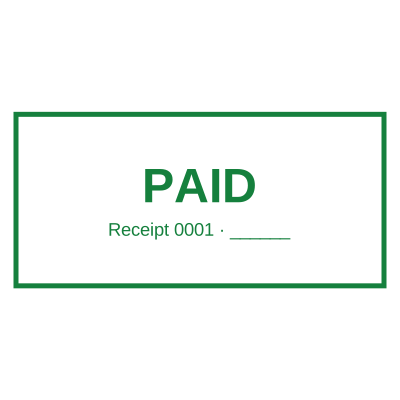
Open the stamp maker and start from any of these
The first is a physical stamp made with less material: a housing moulded from recycled plastic, a replaceable die plate, a pad you swap instead of a stamp you replace. That is a genuine improvement to the object.
The second is a digital stamp, which removes the object and, if the document really stays a file, removes the paper the object existed to mark.
Which of those is the greener choice depends on one thing, and it is not the stamp. It is where your paperwork ends up.
Start by dividing your paperwork in two
Do this before comparing any products, because it decides the answer completely.
Pile one: documents that are paper anyway. A delivery book signed at a door. A form handed across a counter. A ward round sheet in a hospital that runs on paper. A registry submission that must be filed in original ink. These sheets exist whether or not you stamp them.
Pile two: documents that are files. An invoice emailed in and emailed back. A quotation. A purchase order. An internal approval. A contract sent as an attachment.
For pile one, the digital stamp saves nothing, because the paper was never optional. Buy the best physical stamp you can and use it. For pile two, the physical stamp is the thing creating the paper.
Most offices have both piles and treat them as one, which is how the printing habit survives.
What makes a physical stamp genuinely better
If pile one is most of your work, these are the questions worth asking a supplier, and they are the ones that separate a real eco range from a green sticker.
- Is the housing made from recycled plastic, and what proportion? A percentage is an answer. The word "eco" is not.
- Can the pad be replaced? A stamp thrown away because the pad dried out is a whole object wasted for a component.
- Can the die plate be replaced separately? This is the one that matters most, because wording changes are what kill stamps, not wear.
- Is the ink refillable from a bottle, and which ink does the pad take? A pad topped up with the wrong ink smudges everything afterwards, and then the stamp gets replaced.
- What is the die made of? Vulcanised rubber and photopolymer resin are both thermosets and neither is easy to recycle, so this is a smaller lever than the housing.
Ask those five and you will get a straight answer or an evasive one, and either is useful.
What makes a digital stamp genuinely better, and where it does not
The saving from a digital stamp is not in the stamp. It is in the sheets that were never printed.
The arithmetic is worth doing yourself. An A4 sheet at 80 grams per square metre weighs about 5 grams, so a 500 sheet ream is about 2.5 kilograms. Count how many documents your office prints purely in order to stamp them and scan them back in, multiply by your working days, and you have the figure. For a desk doing twenty a day that is 5,000 sheets a year, about 25 kilograms of paper, to add one mark to documents that arrived as files.
Three honest qualifications, because a page making a green claim about its own product should carry them:
- A digital stamp is not zero. It sits on a device and moves through a data centre, and both use electricity. The quantity is small next to running a printer, and it is not nothing.
- If the stamped file gets printed at the other end, nothing has been saved. The saving is the sheet that was never made, not the format the mark arrived in.
- Where the receiving body requires wet ink, the paper is a requirement rather than a habit. Print it.
We are not converting any of this into trees or carbon, because an honest conversion needs emission factors for a specific paper, mill, electricity grid and transport chain. Anybody quoting you a tree count without those is quoting decoration. Paper weight you can check on the packet, which is why the arithmetic above stops there.
The greenest stamp of all
The one you already own, used until it stops working, carrying only details that will not change.
That is a dull answer and it is the right one. The largest single cause of stamps being thrown away is not wear. It is a wording change: a moved office, a new phone number, a new registration, a rebrand. A stamp carrying the company name and nothing volatile outlives one carrying a phone number by years, and the discipline of keeping changeable details off the block is worth more than any eco range.
A working arrangement for most offices
Not either or.
Keep one good physical stamp for the counter and the paper that was always going to be paper. Keep the same mark as a file for everything that arrives and leaves as a file. Set them to the same size so the two impressions match on documents that end up side by side, which means measuring the existing one across its widest point and using that figure.
The thing to stop is the middle case: printing a document you already had, purely so a block can be pressed on it, and scanning it back in. That is the step that costs paper, costs time, and produces a worse copy of the file you started with.
Frequently asked questions
What is an eco friendly stamp?
In the stamp trade it usually means a housing moulded from recycled plastic with a replaceable pad and die. Used more broadly it can mean a stamp held as a file, which removes the object entirely. The two claims are not comparable, so ask which one a seller means before comparing prices.
Are digital stamps environmentally friendly?
They avoid the paper for documents that would otherwise be printed only to be stamped, which is the largest part of the footprint here. They are not free of impact: they run on devices and data centres. Compared with printing a file to stamp it and scanning it back in, the digital version uses less of everything. Compared with a document that was always going to be paper, it saves nothing.
Is recycled paper a good enough answer instead?
It is better than not recycled, and it is a smaller lever than not printing the sheet. If the document is a file at both ends, the sheet is the thing to remove, not to improve.
What do I do with a stamp I no longer need?
Take the pad and the die out if the housing allows it, then check with your local authority whether the plastic body is accepted where you are. As a whole object it is usually general waste, because the bonded mix of plastic, thermoset rubber, felt and steel is exactly what sorting lines cannot separate. Some suppliers take their own stamps back, so it is worth one email before binning it.
Does an eco stamp cost more?
Sometimes, and the comparison people get wrong is the first purchase rather than the run. A stamp with a replaceable die plate costs more once and less every time the wording changes, and wording changes more often than anybody expects.
:::cta
Every kind of stamp and seal
- Notary stamps and seals
- Rubber stamps
- Rubber stamp maker
- Self-inking stamps
- Office stamps
- Official stamps
- Company seals
- Corporate stamps and seals
- Company chops
- Seals for civil servants
- Justice and court stamps
- Legal and advocate stamps
- Certified true copy stamps
- Medical stamps
- Pharmacy stamps
- Veterinary stamps
- Engineer and architect seals
- Land surveyor seals
- Bank stamps
- School and principal stamps
- Teacher and marking stamps
- University and college seals
- Library stamps
- Inspection stamps
- Courier and logistics stamps
- Construction and site stamps
- Real estate stamps
- Hotel and restaurant stamps
- Church and charity seals
- Tender and bid stamps
- HR and payroll stamps
- Received and paid stamps
- Confidential and draft stamps
- Signature stamps
- Date stamps
- Custom band stamps
- Numbering stamps
- Address stamps
- Monogram stamps
- Wedding stamps
- Gift and craft stamps
- Art and logo stamps
- Wax and foil seals
- Stamp or seal, by profession