Blog › Digital stamps for PDF and Word
Stamps and deal speed
16 August 2026 · Estamplab
Make your stamp free · Browse 225 templates


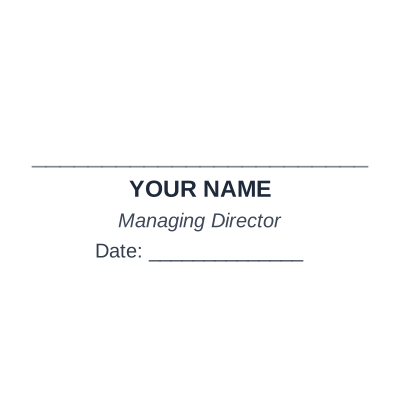

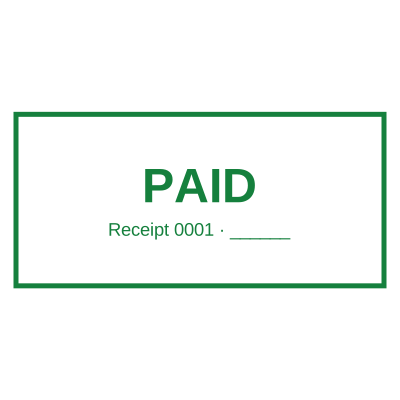
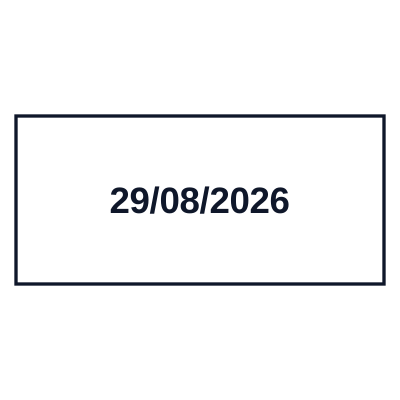
Open the stamp maker and start from any of these
Negotiations end long before deals close. Everyone has agreed, the terms are settled, and then the document spends four days somewhere between two organisations for reasons nobody would defend if you asked them directly.
A surprising amount of that time is execution mechanics, and in a great many markets the company stamp is one of them.
Where the time actually goes
Watch a deal in the last mile and the pattern repeats.
The signatory has signed. The stamp is in another office. The document is complete except for a mark, and the mark is behind a locked drawer, a commute or a person on leave. Nothing about the deal is unresolved. It is a logistics problem wearing a legal costume.
The counterparty asks for a stamped copy. Common across Asia, the Gulf, Africa and India, and often not a legal requirement so much as their internal policy. Their policy still binds you: their finance team will not process it without one.
It is stamped, then scanned, then it comes back blurry. A stamp photographed at an angle or scanned at low quality gets queried, and the round trip repeats.
The wording is wrong. The company moved office and the stamp still shows the old address. Now it is a reorder, and a reorder is days.
None of these is about the deal. All of them delay revenue.
Why it is worse across borders
A deal between a company in Nairobi and one in Frankfurt has two different sets of expectations about the same mark. One side thinks it is essential; the other has never owned one. Neither is wrong for its own market.
The practical effect is that whoever expects the stamp will wait for it, and the side that does not have one now has to acquire one before the deal can close. If that is a physical die, you have just added several days to a transaction that was already agreed.
A stamp that is a file removes exactly that delay. The counterparty gets what their process requires, the same afternoon.
The compounding version
For a business closing a handful of deals a year, this is annoying. For one closing several a week, it compounds into something worth measuring.
Take the number of agreements you execute a month, and the average number of days each one sits waiting on execution mechanics rather than on a decision. In most organisations that have not looked, the second number is between one and four, and almost all of it is avoidable.
Multiply through and you have both a working capital cost, because invoicing usually starts at execution, and a conversion cost, because a deal that stays open is a deal that can still be reconsidered.
What actually removes it
One thing, and it is unglamorous: the mark stops being an object. A digital stamp for documents is applied where the file already is, so nothing waits for anybody to be in a particular room.
The stamp becomes a file. It cannot be in the wrong office because it is in every office. It cannot be locked in a drawer.
The date fills itself in. A stamp whose date resolves when it is used records the day of execution correctly without anybody remembering to update anything. On a dated agreement that is not cosmetic: the execution date is what the clock runs from.
Changes are edits. A new address does not stop the deal for three days while a new die is cut.
Every format comes out of one design. The counterparty who wants it in Word, the one who wants a PDF, and the one who wants it on paper are all served without a redesign.
The mark is traceable. A saved stamp can carry a serial number that has never been issued before, so an executed document ties back to one impression rather than to a stamp that looks the same on everything.
Where automation stops
The mark still means somebody authorised something, and that judgement stays with a person. Automating who may stamp what would be a bad idea and is not what any of this is for.
What gets automated is the clerical layer around the decision: the date, the numbering, the availability of the mark, the format the other side needs. Those are the parts that generate delay, and none of them require judgement at all.
Starting
The cheapest version of this is to stop printing. Make the mark once in the free company stamp maker, download it as a transparent PNG, and the print, stamp, scan, email loop disappears from every deal after it.
Design the stamp with the entity name and registration number, save it so it carries its own serial sequence, and download the formats your counterparties actually ask for. The next agreement executes the same day it is agreed.
Free to design and preview at estamplab.com, with no account needed to start.
Estamplab is a design tool. This describes common commercial practice rather than legal advice, and what a specific counterparty or registry requires is a question for them.
Every kind of stamp and seal
- Notary stamps and seals
- Rubber stamps
- Rubber stamp maker
- Self-inking stamps
- Office stamps
- Official stamps
- Company seals
- Corporate stamps and seals
- Company chops
- Seals for civil servants
- Justice and court stamps
- Legal and advocate stamps
- Certified true copy stamps
- Medical stamps
- Pharmacy stamps
- Veterinary stamps
- Engineer and architect seals
- Land surveyor seals
- Bank stamps
- School and principal stamps
- Teacher and marking stamps
- University and college seals
- Library stamps
- Inspection stamps
- Courier and logistics stamps
- Construction and site stamps
- Real estate stamps
- Hotel and restaurant stamps
- Church and charity seals
- Tender and bid stamps
- HR and payroll stamps
- Received and paid stamps
- Confidential and draft stamps
- Signature stamps
- Date stamps
- Custom band stamps
- Numbering stamps
- Address stamps
- Monogram stamps
- Wedding stamps
- Gift and craft stamps
- Art and logo stamps
- Wax and foil seals
- Stamp or seal, by profession