Carve your own rubber stamp: what works and what does not
3 September 2026 · Estamplab
Make your stamp free · Browse 225 templates
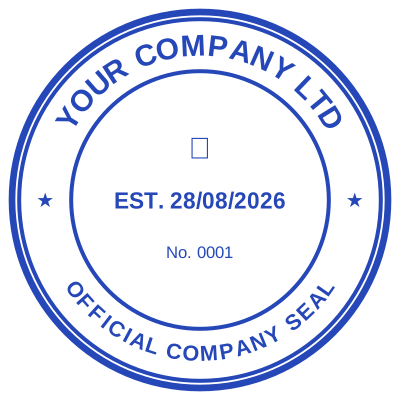

Open the stamp maker and start from any of these
Carving a stamp by hand is satisfying, cheap for one, and the only route that gives you something nobody else has. It is also the wrong answer for about half the stamps people try to carve, and knowing which half saves an afternoon.


Open the stamp maker and start from any of these
What you need
- A carving block. Soft rubber carving blocks are the usual choice: easier than lino, no heating, and they take detail well. Traditional lino is harder, holds a crisper edge, and is unforgiving.
- Gouges. A U-gouge for clearing, a fine V-gouge for outlines. Two blades cover most work.
- A cutting mat and a bench hook, so the block does not move and the gouge does not travel towards your hand.
- An ink pad suited to what you are stamping. See stamp ink types.
The reverse-image problem
Everything you carve prints mirrored. For a motif this does not matter. For text it matters completely, and it is where most first attempts fail: the letters have to be carved backwards, and a design carved the right way round prints as a mirror.
The standard fix is to draw the design on paper in pencil, lay it face down on the block and burnish the back, which transfers a mirrored copy. A soft pencil and a bone folder or the back of a spoon is all it takes.
Even done correctly, hand-carved lettering looks hand carved. That is charming on a craft mark and wrong on a company name, which is the honest reason to cut text a different way.
What survives carving
Bold shapes. A leaf, a monogram, a simple emblem, a border.
Thick lines. Anything below about 1.5mm is fragile in soft rubber and will tear at the edges or fill with ink.
Negative space you actually clear. Ink sits in shallow gouges and prints as a grey smudge. Clear a good 2mm deep between elements, wider than feels necessary.
Not: fine text, hairlines, tight cross-hatching, or a company logo with small type in it. Those are what a cut die or a digital file is for.
Design it first
The mistake is starting with the gouge. Lay the design out first, look at it at the size the block actually is, and simplify until it looks slightly too plain. That is usually correct once ink and paper have their say.
You can do that here: set the shape and the elements, look at it at 38 or 56mm, then print it and transfer it. The template gallery is 225 starting layouts, and the simple badge and emblem ones reduce best for carving.
Cutting, briefly
Cut away from yourself, always. Outline first with the V-gouge, about 2mm outside the line you want to keep, then clear the background with the U-gouge. Test print early and often: ink it, press it, and you will see immediately where ink is catching in ground you have not cleared.
Trim the block close to the design at the end. A wide margin catches ink and prints as a grey frame.
Looking after it
Clean it while the ink is wet with water and a soft cloth for water-based inks, or a purpose-made cleaner for pigment. Dried pigment in a carved groove is nearly impossible to get out and changes the impression.
Store it flat, face up, away from sunlight. Soft carving rubber perishes and goes brittle.
Read more: Pressure, pad and paper: getting a clean print
When to carve and when not to
Carve a motif, a pattern, a monogram, a packaging mark. Do not carve a company stamp, a notary mark, a date stamp or anything carrying a registration number. Those need lettering that is legible after a hundred impressions and a photocopy, and hand carving cannot promise that.
For those, design the layout, then either have a die cut from the vector or use the file directly. See where to make a custom stamp.
The honest limits
Estamplab is a design tool. This page describes common craft practice rather than giving legal advice. What an official or professional mark must carry is set by the authority that issued the commission or registration, so check the requirement with them, and only produce a mark you are entitled to use.
The full range is on the stamp and seal directory.
Every kind of stamp and seal
- Notary stamps and seals
- Rubber stamps
- Rubber stamp maker
- Self-inking stamps
- Office stamps
- Official stamps
- Company seals
- Corporate stamps and seals
- Company chops
- Seals for civil servants
- Justice and court stamps
- Legal and advocate stamps
- Certified true copy stamps
- Medical stamps
- Pharmacy stamps
- Veterinary stamps
- Engineer and architect seals
- Land surveyor seals
- Bank stamps
- School and principal stamps
- Teacher and marking stamps
- University and college seals
- Library stamps
- Inspection stamps
- Courier and logistics stamps
- Construction and site stamps
- Real estate stamps
- Hotel and restaurant stamps
- Church and charity seals
- Tender and bid stamps
- HR and payroll stamps
- Received and paid stamps
- Confidential and draft stamps
- Signature stamps
- Date stamps
- Custom band stamps
- Numbering stamps
- Address stamps
- Monogram stamps
- Wedding stamps
- Gift and craft stamps
- Art and logo stamps
- Wax and foil seals
- Stamp or seal, by profession