Where to make a custom stamp: five routes, honestly compared
3 September 2026 · Estamplab
Make your stamp free · Browse 225 templates


Open the stamp maker and start from any of these
There are five ways to end up with a custom stamp, and which one is right depends almost entirely on one question: what is the stamp going onto? Answer that and the choice makes itself. Four of the five are not us, and this page says so.
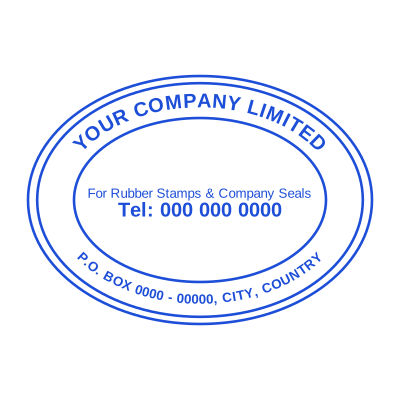
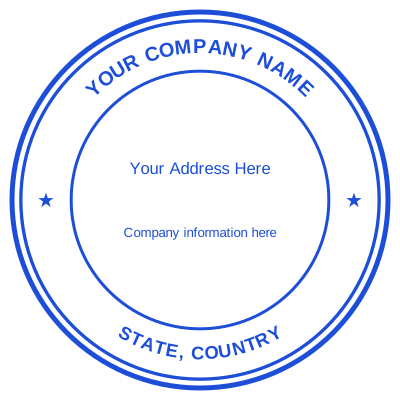
Open the stamp maker and start from any of these
1. Carve it yourself
A rubber or lino block, a set of gouges, and an afternoon. Cheapest for one stamp, and the only route that produces something nobody else has.
Good for: patterns, motifs, craft and packaging marks, anything where a slightly irregular impression is part of the appeal.
Bad for: text. Carving legible letters in reverse by hand is genuinely hard, and a company name will look hand-carved because it is. See carve your own rubber stamp.
2. A local stamp shop
The shop that also cuts keys and does engraving. You bring wording or artwork, they cut a die and mount it, usually in a day or two.
Good for: a physical stamp you need this week, sizing advice from somebody holding the thing, and self-inking mounts.
Bad for: anything you want to change later. The die is cut once, so a new address means a new stamp. Bring them a vector rather than a sketch: designing it here and downloading the SVG or print-ready PDF gives them something to cut from directly.
3. An online stamp supplier
Type your wording into a form, pick a mount, and it arrives by post in a week or so. This is what most people mean by ordering a stamp online.
Good for: self-inking office stamps at a fair price, and buying five at once.
Bad for: anything unusual. The form constrains you to their layouts, proofs are small, and the loop between spotting a mistake and getting a corrected stamp is another week. Costs also stack up in a way the price does not show: see what a rubber stamp actually costs.
4. A print shop or trophy shop
For embossers, wax seal matrices, foil dies and anything metal. They work from artwork rather than from a form.
Good for: wax and foil seals, embossers, and marks where the physical object is the point.
Bad for: everyday stamping, on cost and on turnaround.
5. A digital stamp maker
Design it in the browser, download a file, put it straight onto the document. No die, no post.
Good for: anything that arrives as a PDF or a Word file, which is most business paperwork now. Also good as the artwork step for routes 2 and 4, because a vector is a far better brief than a photo of your letterhead.
Bad for: envelopes and paper handed over in person. An address stamp is the honest case where rubber wins.
Which one fits
- It goes on PDFs, invoices, contracts, scans. Digital. Printing to stamp and scanning back loses quality twice.
- It goes on envelopes and parcels. Rubber, from a shop or an online supplier.
- It goes on fabric, wood or packaging. Rubber, and see stamping on fabric and other surfaces.
- It has to be embossed or in wax. Print or trophy shop.
- It is a decorative motif and you enjoy making things. Carve it.
- You have been asked for a company mark and are not sure which. Start with official stamps, which sorts out what people mean when they ask.
The step people skip
Designing and ordering are separate steps, and merging them is where money gets wasted. Design first, look at it at real size, then decide how it gets made. Order-form-first means proofing a small preview under time pressure, which is how a stamp arrives with the wrong registration number on it.
Designing here is free and needs no account, so you can settle the layout before you commit to a die.
Read more: The eleven questions worth asking before you pay
The honest limits
Estamplab is a design tool. This page describes common commercial practice rather than giving legal advice, and what a mark must carry for a particular document is set by the authority receiving it, so check the requirement with them.
Only produce a mark you or your organisation are entitled to use.
The full range is on the stamp and seal directory.
Every kind of stamp and seal
- Notary stamps and seals
- Rubber stamps
- Rubber stamp maker
- Self-inking stamps
- Office stamps
- Official stamps
- Company seals
- Corporate stamps and seals
- Company chops
- Seals for civil servants
- Justice and court stamps
- Legal and advocate stamps
- Certified true copy stamps
- Medical stamps
- Pharmacy stamps
- Veterinary stamps
- Engineer and architect seals
- Land surveyor seals
- Bank stamps
- School and principal stamps
- Teacher and marking stamps
- University and college seals
- Library stamps
- Inspection stamps
- Courier and logistics stamps
- Construction and site stamps
- Real estate stamps
- Hotel and restaurant stamps
- Church and charity seals
- Tender and bid stamps
- HR and payroll stamps
- Received and paid stamps
- Confidential and draft stamps
- Signature stamps
- Date stamps
- Custom band stamps
- Numbering stamps
- Address stamps
- Monogram stamps
- Wedding stamps
- Gift and craft stamps
- Art and logo stamps
- Wax and foil seals
- Stamp or seal, by profession