Blog › Stamps around the world
EU VAT invoice requirements, and where a stamp still gets asked for
5 September 2026 · Estamplab
Make your stamp free · Browse 225 templates
Selling across the EU means two separate things are true at once. There is one harmonised list of what an invoice must contain, set by the VAT Directive and the same in every member state. And there are twenty-seven different habits about whether a document looks credible without a stamp on it.

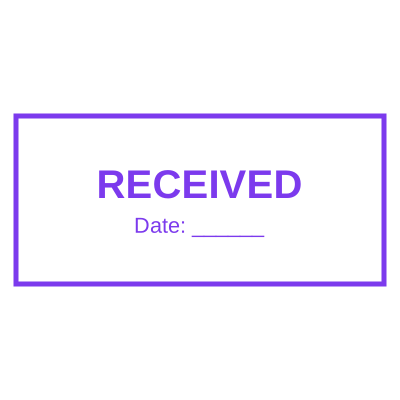
Open the stamp maker and start from any of these
The first is law. The second is what decides whether your invoice gets paid without a phone call.
For what each country puts on the stamp itself, see stamp makers in Europe. This page is about the invoice.
The fields an EU VAT invoice must carry
Article 226 of the VAT Directive sets the list, and member states implement it with only minor variation:
- The date of issue.
- A sequential number that uniquely identifies the invoice.
- The supplier's VAT identification number.
- The customer's VAT identification number, where the customer is liable for the tax.
- The full name and address of both supplier and customer.
- The quantity and nature of the goods or services.
- The date of supply, where it differs from the date of issue.
- The taxable amount per rate, the unit price excluding VAT, and any discounts.
- The VAT rate applied.
- The VAT amount payable, unless a special scheme applies.
- Where the customer accounts for the tax, the words reverse charge.
- Where an exemption applies, a reference to the provision that grants it.
Simplified invoices are permitted below a threshold that varies by member state, commonly around 100 euro.
What a stamp can and cannot carry
The same division as anywhere: a stamp holds what is fixed and cannot hold what varies.
Fixed, so suitable for a stamp: your registered company name, legal form, registered address, national register number and your VAT identification number.
Per invoice, so never on a stamp: the invoice number, the dates, the customer, the amounts, the VAT rate and the reverse charge wording. A stamp that carries a VAT rate will be wrong the first time you sell at a different one.
Which member states still expect a stamp
No EU member state requires a company stamp for an invoice to be valid. The VAT Directive does not mention stamps, and an unstamped invoice carrying the Article 226 fields is a valid invoice everywhere in the union.
Expectation is another matter, and it runs roughly on an old administrative divide. In Poland, Romania, Bulgaria, Greece, Czechia, Slovakia, Hungary and the Baltic states a company stamp is still commonly used and often still asked for, even where national law dropped the requirement years ago. In the Netherlands, the Nordics and Ireland it is unusual and its absence is not remarked on. Germany, France, Italy, Spain and Portugal sit in between: not required, widely kept, and expected more by smaller and older counterparties than by large ones.
Outside the EU the expectation strengthens sharply, which matters if you export to the Gulf, North Africa or East Asia. Company stamps by country has the wider picture.
The stamp that is worth having anyway
Not the one on your outgoing invoice, but the one on the incoming ones. Payment terms under the EU Late Payment Directive run from receipt of the invoice, and a dated RECEIVED mark is the cheapest way to have a record of that date.
The full layout is in invoice approval and coding stamps, and for a mark applied to a PDF rather than to paper the PDF stamping tool works in the browser.
Do not confuse this with an electronic seal
A picture of a stamp on a PDF is not an electronic seal in the eIDAS sense, and the two get mixed up constantly because the words overlap. A qualified electronic seal is a certificate issued to an organisation by a qualified trust service provider, and it is what carries legal presumption for an electronic document. The image is an identifier and nothing more.
Both are explained in electronic seals, electronic stamps and e-stamps and in digital signature, electronic seal and a stamp.
Common questions about EU invoices and stamps
Does an EU invoice need a company stamp?
No. No member state requires one for an invoice to be valid, and the VAT Directive does not mention stamps at all. Customers in central and eastern Europe often still expect one, which is a commercial reason to have one rather than a legal one.
What must an EU VAT invoice contain?
The date of issue, a unique sequential number, both parties' names and addresses, the supplier's VAT number, the customer's VAT number where they account for the tax, a description of the supply, the taxable amount, the VAT rate and the VAT amount, plus the words reverse charge where that applies.
Can I put my VAT number on a company stamp?
Yes. The VAT identification number is fixed, so it belongs with the company name and address on the stamp. The invoice number and the VAT amounts are not fixed and must not come from a stamp.
Is a stamped PDF the same as a qualified electronic seal?
No. A stamp on a PDF is an image identifying the issuer. A qualified electronic seal is a certificate issued to an organisation by a qualified trust service provider under eIDAS, and only that carries the legal presumption of integrity and origin.
What is the reverse charge wording on an invoice?
Where the customer rather than the supplier accounts for the VAT, the invoice must say so. The Directive requires the words reverse charge, and the exact phrase your national law expects should be checked, since some member states specify their own wording.
The honest limits
Estamplab is a design tool, and this page describes common commercial practice rather than giving legal, tax or accounting advice. VAT invoicing is set by the VAT Directive as implemented in each member state, thresholds and wording differ between them, and the rules change, so check the requirement with your own tax authority or your accountant.
Only produce a mark your own organisation is entitled to use. Making one for a business you do not act for is forgery.
The rest of the range is on the stamp and seal directory.
Every kind of stamp and seal
- Notary stamps and seals
- Rubber stamps
- Rubber stamp maker
- Self-inking stamps
- Office stamps
- Official stamps
- Company seals
- Corporate stamps and seals
- Company chops
- Seals for civil servants
- Justice and court stamps
- Legal and advocate stamps
- Certified true copy stamps
- Medical stamps
- Pharmacy stamps
- Veterinary stamps
- Engineer and architect seals
- Land surveyor seals
- Bank stamps
- School and principal stamps
- Teacher and marking stamps
- University and college seals
- Library stamps
- Inspection stamps
- Courier and logistics stamps
- Construction and site stamps
- Real estate stamps
- Hotel and restaurant stamps
- Church and charity seals
- Tender and bid stamps
- HR and payroll stamps
- Received and paid stamps
- Confidential and draft stamps
- Signature stamps
- Date stamps
- Custom band stamps
- Numbering stamps
- Address stamps
- Monogram stamps
- Wedding stamps
- Gift and craft stamps
- Art and logo stamps
- Wax and foil seals
- Stamp or seal, by profession