Stamp ink smudging, and why it happens
29 August 2026 · Estamplab
Make your stamp free · Browse 225 templates

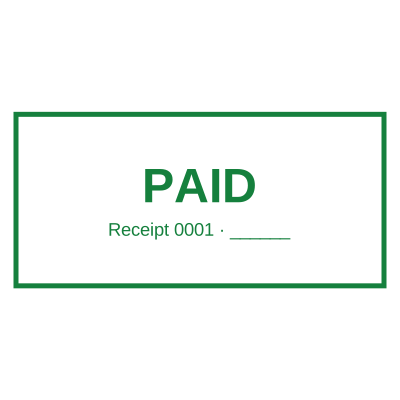



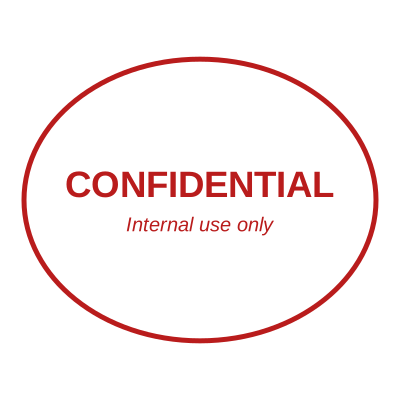
Open the stamp maker and start from any of these
You press the stamp. You lift it. And there, across the client name on a contract you are about to send, is a blue smear with a thumbprint in it.
Now you reprint the page. You find the stamp again. You press more carefully this time, and it comes out grey and half missing, because the pad you just over inked has now given up its best ink to the last three attempts. So you re ink it. And the next one blots.
Every office that owns a rubber stamp knows this cycle, and almost nobody talks about it, because it feels too small to complain about. It is not small. It is a document you cannot send, on a day you needed to send it.
What is actually going wrong
Too much ink. A freshly inked pad holds far more than the rubber needs. The excess sits in the recesses of the die, the parts that are supposed to stay dry, and the moment you press, it floods out. The result is a mark with the letters filled in and a halo around the edge.
Too little ink. On a self inking stamp the pad dries from the outside in and from the top down. The stamp keeps working until it suddenly does not, and the failure looks like a ghost: an outline with the middle missing, which is worse than nothing because it looks like a forgery.
The paper. Coated or glossy stock does not absorb. The ink sits on the surface and transfers to whatever touches it next, which is usually the next page in the stack and sometimes the back of your own hand.
The pressure. Too light and you get half a ring. Too hard and the rubber deforms and spreads the line. There is a correct pressure and nobody has ever been taught it.
Time. Stamp a page and put it face down before it has dried and you have stamped two documents, one of them backwards.
The honest summary is that a rubber stamp has a small window in which it works, and outside that window it produces a mark that is worse than no mark at all, because a smudged company seal on a contract does not look casual. It looks careless, and on the wrong document it looks suspicious.
Read more: How rubber stamps are actually made: vulcanising, photopolymer and lasers
The version with no ink in it
A digital stamp cannot smudge. There is nothing to smudge with. A stamp built in Estamplab is a file, and a file has no pad, no ink and no drying time.
Press it on the fiftieth document and it is identical to the first. Identical on the invoice, identical on the delivery note, identical on the scan the bank keeps on file. No pad, no re inking, no ghost impressions, no drying time, no ink on your fingers at the exact moment somebody walks in.
And it is not a picture of a stamp. It is a real transparent PNG, so it floats over the page and the text underneath stays readable, exactly the way ink behaves on paper, and unlike a plain image which lands as a white box that hides the line beneath it.
A good online stamp designer does not force you to give up the look. If you want the character of rubber, you can have that too, deliberately rather than by accident: there is an aging control that adds the worn edge of a real rubber impression, and you set how much. The difference is that you choose it, and it is the same every single time.
What you stop doing on the day you switch
- Buying ink pads
- Re inking, and getting it wrong
- Reprinting pages
- Waiting for ink to dry before you file or scan
- Explaining a smeared seal to a client
- Cleaning a die with a cloth and some spirit at the end of a long week
- Finding out on a Friday afternoon that the pad has finally gone
What comes out instead
A transparent PNG for PDFs, Word and email. A vector SVG if you ever do want a physical block cut properly. A PDF of the stamp on its own. A date that fills itself in on the day you use it. A serial number that counts on the server and never repeats. Your logo, with the white background knocked out so it reads as ink.
Designing it is free and there is no clock on it. No subscription, nothing to cancel. And no watermark on your file: the previews on this site are marked because they are public, but your download is rendered again from your own design, clean.
Frequently asked questions
Why is my rubber stamp not printing clearly?
Work through it in this order, because the causes are ranked by how often they are the answer. Too much ink, which floods the recesses of the die and fills in the letters. Too much pressure, which deforms the rubber and pushes ink sideways into the paper. A coated or glossy paper that will not absorb, so the ink sits on the surface and transfers to the next thing it touches. And a die that has never been cleaned, where old dried ink is holding the fine detail shut. Good rubber stamp design helps here too: fine hairlines are the first thing to clog.
Why is my stamp blurry or smudged?
Movement, almost always. A stamp needs firm even contact and then a straight lift. Rock it, drag it a millimetre, or roll off one edge and you get a doubled or smeared line. Press down, hold for a moment, lift straight up. And if you have just re inked, blot the pad on scrap paper several times before you go near a real document, because a freshly flooded pad is the single most common cause of a blotted impression.
Do self inking stamps dry out?
Yes, and they do it slowly enough that nobody notices. The pad dries from the outer edges inward, so the impression thins for weeks before anyone concludes the stamp is finished. That is why the failure always seems to arrive on the worst possible afternoon. A faint half printed seal is worse than none at all on anything that will be scanned, because it reads as a bad photocopy of something rather than as a mark.
How do I stop a stamp smudging for good?
The trade answer is: use less ink, press evenly, lift straight, choose a fast drying ink for coated stock, and let the page sit before you stack it. The other answer is that a stamp with no ink in it cannot smudge, cannot dry out, cannot flood, and gives you the same impression on the five hundredth document as on the first.
Can a digital stamp look like a real rubber stamp?
Yes, and better than most people expect. There is an aging control that adds the worn edge and slight break up of a genuine impression, and you decide how much of it you want. The difference from real rubber is that it is consistent: every impression is the one you chose.
Will the stamp cover the text on my document?
Not here. The download is a real transparent PNG with an alpha channel, so only the ink lands and everything underneath stays visible. You can overlap the signature deliberately, the way a real stamp does.
Is it free to make one?
Designing, editing and previewing at full size are free and unlimited. The download pack is a one off purchase rather than a subscription.
Every kind of stamp and seal
- Notary stamps and seals
- Rubber stamps
- Rubber stamp maker
- Self-inking stamps
- Office stamps
- Official stamps
- Company seals
- Corporate stamps and seals
- Company chops
- Seals for civil servants
- Justice and court stamps
- Legal and advocate stamps
- Certified true copy stamps
- Medical stamps
- Pharmacy stamps
- Veterinary stamps
- Engineer and architect seals
- Land surveyor seals
- Bank stamps
- School and principal stamps
- Teacher and marking stamps
- University and college seals
- Library stamps
- Inspection stamps
- Courier and logistics stamps
- Construction and site stamps
- Real estate stamps
- Hotel and restaurant stamps
- Church and charity seals
- Tender and bid stamps
- HR and payroll stamps
- Received and paid stamps
- Confidential and draft stamps
- Signature stamps
- Date stamps
- Custom band stamps
- Numbering stamps
- Address stamps
- Monogram stamps
- Wedding stamps
- Gift and craft stamps
- Art and logo stamps
- Wax and foil seals
- Stamp or seal, by profession