Blog › Company stamps and seals
Electronic chops: the company chop as a file
4 September 2026 · Estamplab
Make your stamp free · Browse 225 templates
An electronic chop is the company chop in digital form. Same round red mark, same registered name around the ring, same authority behind it. The difference is that it lives as a file rather than as a block of rubber or stone in a locked drawer, so it can be applied to a contract that arrives by email at ten at night from an office two provinces away.



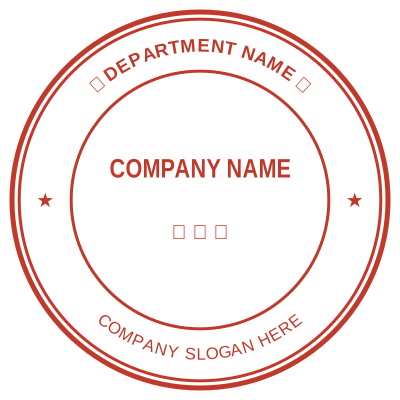


Open the stamp maker and start from any of these
For the physical article, what the different chops are and who holds them, see company chops: what they are and who controls them. For the European instrument that shares part of the name, see electronic seals, electronic stamps and e-stamps. This page is the chop specifically.
Why this matters more than it would in London
In much of East and South East Asia the chop, not the signature, is what binds the company. A contract carrying the company chop is the company's act. That is why the chop sits in a safe, why one named person is responsible for it, and why losing it is a genuine crisis rather than an errand.
Take a mark with that much weight and move it onto documents that now arrive as PDFs, and the question of what its digital form is stops being cosmetic. Company stamps by country sets out how much the answer varies.
The two things people mean by "electronic chop"
Worth separating, because they are not the same and the word covers both.
The mark as an image. A transparent file of the company chop, applied to a PDF or a Word document the way the physical one is pressed onto paper. It looks identical to the wet impression, it is what most day to day commercial documents carry, and it proves exactly as much as the mark itself does, which is that whoever holds the file applied it.
The chop backed by a credential. The same visible mark, but attached to the document through a service that records who applied it and when, and that seals the file so later edits show. In mainland China this sits under the Electronic Signature Law and is offered by licensed providers; the visible red circle is the part you see, and the certificate underneath is the part that does the work.
Estamplab makes the first. The second is a service a company subscribes to, and the two are complementary rather than alternatives: the mark still has to be designed before anything can apply it. The general version of this distinction is in digital signature, electronic seal and a stamp.
An electronic chop is not a scan of your chop
This is the part worth being blunt about, because the shortcut is obvious and it is the wrong one.
Photographing or scanning a chop impression off a signed contract gives you an image of the chop. It also gives that image to anyone else who has a copy of that contract, and a chop lifted off a scan can be pasted onto anything. Documents circulating with a visible chop on them are, in effect, publishing the mark.
A designed electronic chop is rebuilt rather than copied, which means:
- It is sharp at any size, instead of carrying the grain of whatever paper it was pressed on.
- The characters are type, so they stay readable after the document is scanned, printed and scanned again.
- It can be reissued when the registered name or address changes, which a scan cannot.
- You control the file rather than depending on whichever old contract had the cleanest impression.
None of that stops someone copying the mark off a document later. Nothing does, which is why a chop's real security has always been the record of who was authorised to apply it rather than the picture itself. How to spot a fake stamp covers what people actually check.
Designing an electronic chop
The chop's appearance is conventional, and convention is the point: a chop that does not look like a chop invites a phone call.
- Round, and red. Vermilion is the expected colour and the one that reads as a chop rather than as a western office stamp. Stamp colours covers why red carries this meaning here and blue does not.
- The registered name in the outer ring, exactly as registered, running around the top. The curved text refits the spacing as the name changes length, which matters when a full Chinese company name is long.
- A star in the centre for a mainland company chop, or the registration number, or both stacked.
- The registration number along the bottom, reading upright.
- One weight of line, no fine detail. A chop is read small and often reproduced badly.
- Download it transparent. A transparent PNG sits on the document as ink; a JPEG sits on it as a white square. Stamp file formats covers when you want the vector instead.
The chops a company holds, and their electronic versions
Not one mark but several, each with its own authority: the company chop itself, the legal representative's chop, the finance chop, the invoice chop, the contract chop. They are held by different people on purpose, because splitting them splits the ability to bind the company.
Going electronic does not merge them. If anything it makes the separation easier to hold, because a file can be issued to one person's account rather than left in a drawer the whole floor can reach. The full breakdown is in the company chop guide.
The electronic chop under other names
- Hong Kong and Taiwan. The company chop alongside a common seal, and the same move to files for documents that travel.
- Japan. The hanko or inkan, and the registered jitsuin for company acts. The digital form is usually called a denshi inkan, and the government push away from paper hanko has made it ordinary.
- South Korea. The dojang, and the registered ingam for formal use.
- India, Bangladesh, Pakistan and much of Africa. The word is stamp or seal rather than chop, but the role is the same: the company mark that makes a document official.
What each market calls the mark is in stamp or seal by profession and company stamps by country.
Why companies moved to an electronic chop
The physical chop has one property that stopped working: it can only be pressed by someone standing next to it. Contracts that close over email, invoices approved from a phone, and offices in three cities all run into the same wall, and the workaround (couriering paper, or worse, mailing photographs of the chop around) is worse than the problem. Physical stamp problems has the rest of the list, and why company stamps went digital has the argument.
Read more: Whether an applied mark is accepted, and on what
Common questions about electronic chops
What is an electronic chop?
An electronic chop is the company chop in digital form: the same round red mark with the registered name around the ring, held as a file rather than as a physical block kept in a safe. It is applied to a PDF or a Word document on screen instead of being pressed onto paper.
Is an electronic chop the same as a scan of our chop?
No, and the difference matters. A scan is an image lifted off a document, which means everyone holding a copy of that document has the same image. A designed electronic chop is rebuilt from the wording, so it stays sharp at any size, stays readable after repeated scanning, and can be reissued when the registered details change.
How do I make an electronic chop?
Choose a round template, set the registered name in the outer ring, put a star or the registration number in the centre, add the number along the bottom, and set the ink to vermilion red. Download it as a transparent PNG for documents, or as a vector if a maker will cut a physical chop from it.
Is an electronic chop legally valid?
That depends on the document and the jurisdiction rather than on the chop. Many everyday commercial documents are accepted with the mark applied as an image. Where a legally recognised electronic chop is required, it has to be backed by a certificate from a licensed provider, and that is a service a company subscribes to.
The honest limits
Estamplab is a design tool that produces the mark as a file. It is not a certification authority, it does not register chops, and it does not issue the credential that a legally recognised electronic chop is built on.
This page describes common commercial practice rather than giving legal advice. What an electronic chop must be backed by, and whether a given document accepts one, is set by the authority or the counterparty receiving it and differs sharply between jurisdictions, so check the requirement with them or with a local adviser before relying on it.
Only produce a chop your own company is entitled to use. Applying another company's chop, or recreating one from a document you received, is forgery, and in the markets where the chop binds the company it is treated as seriously as that implies.
The rest of the range is on the stamp and seal directory.
Every kind of stamp and seal
- Notary stamps and seals
- Rubber stamps
- Rubber stamp maker
- Self-inking stamps
- Office stamps
- Official stamps
- Company seals
- Corporate stamps and seals
- Company chops
- Seals for civil servants
- Justice and court stamps
- Legal and advocate stamps
- Certified true copy stamps
- Medical stamps
- Pharmacy stamps
- Veterinary stamps
- Engineer and architect seals
- Land surveyor seals
- Bank stamps
- School and principal stamps
- Teacher and marking stamps
- University and college seals
- Library stamps
- Inspection stamps
- Courier and logistics stamps
- Construction and site stamps
- Real estate stamps
- Hotel and restaurant stamps
- Church and charity seals
- Tender and bid stamps
- HR and payroll stamps
- Received and paid stamps
- Confidential and draft stamps
- Signature stamps
- Date stamps
- Custom band stamps
- Numbering stamps
- Address stamps
- Monogram stamps
- Wedding stamps
- Gift and craft stamps
- Art and logo stamps
- Wax and foil seals
- Stamp or seal, by profession